Table of Contents
The question “should I stay or should I go” tends to get asked on repeat after an affair, waiting for the moment it finally arrives with certainty attached. It usually doesn’t, and waiting for it is its own kind of decision.
Certainty isn’t coming, and waiting for it is its own kind of decision. Here’s a framework for choosing with clear eyes instead. Consider the question of whether to Stay After Betrayal as you navigate this process.
TL;DR:
After discovering an affair, the question “should I stay or should I go” tends to get asked over and over, hoping that one day it will arrive with a feeling of total certainty attached. It usually doesn’t. This article walks through a research-informed way of separating a pattern from a moment, what genuine repair actually looks like compared to performed remorse, and why the first 48 hours after discovery call for stabilising, not deciding. The goal isn’t to hand you an answer. It’s to give your thinking brain a structured way to evaluate what your nervous system may already sense. When contemplating your options, think about how to Stay After Betrayal.

Key Takeaways
- Certainty is not a prerequisite for a sound decision – Waiting to feel completely sure before deciding anything often means waiting indefinitely.
- Patterns matter more than any single moment – One red flag doesn’t determine the outcome. A consistent pattern across multiple areas does.
- Genuine remorse and performed remorse look different up close – Specificity, timing, and follow-through distinguish real accountability from damage control.
- The first 48 hours are for stabilising, not deciding – Major, permanent decisions made in the acute aftermath tend to serve panic more than clarity.
- This is a framework, not a verdict – It organises what you already know. It doesn’t replace your own judgment.
Why Certainty Never Arrives
There’s a particular kind of waiting that happens after discovering an affair. You tell yourself you’ll know what to do once you feel certain. You wait for the fog to clear, for one decisive piece of evidence, for a feeling so unmistakable that the decision makes itself.
Here’s the uncomfortable truth almost no one says directly: that certainty, in the clean, simple form you’re hoping for, usually doesn’t arrive. Not because you’re failing to find it, but because reconciliation decisions rarely resolve into pure clarity. They resolve into a weighing of evidence, much closer to how decisions get made every day, than to the singular lightning-bolt moment culture tends to promise.
Waiting for certainty before deciding anything isn’t neutral. It’s its own decision, just one made by default rather than by choice, and it often keeps you in the same uncertain place for far longer than a structured evaluation would.
The Difference Between a Pattern and a Moment
One of the most useful shifts available to you right now is learning to evaluate patterns instead of individual moments. A single apology, a single good week, a single distressing discovery, none of these, on their own, tell you what you actually need to know.
Researchers who’ve spent decades studying relationship repair, including John Gottman’s work on what predicts relationship breakdown, and Shirley Glass’s clinical research specifically on infidelity recovery, point to recognisable indicators that tend to cluster on either side of a genuine repair process.
On one side sit signs that repair is unlikely or that you may be experiencing ongoing manipulation: minimising what happened, blaming you for the affair in any form, truth that only emerges in pieces as you uncover more evidence rather than being offered voluntarily, impatience with your healing timeline, continued contact with the affair partner that hasn’t been proactively and fully addressed.
On the other side sit signs that genuine reconciliation may be possible: voluntary disclosure rather than disclosure forced by discovery, contact with the affair partner ended immediately and completely, willingness to answer hard questions honestly without defensiveness, individual therapy focused on understanding their own choices rather than just attending couples sessions for appearances, and unprompted accountability that shows up without you having to ask for it.
No single item on either list determines the outcome by itself. What matters is the overall pattern across weeks, not any individual gesture, good or bad.
Genuine Repair vs. Performed Remorse
This distinction, more than almost anything else, separates the cases where reconciliation has a real chance from the ones where it’s likely to repeat.
Performed remorse tends to appear when pushed, when consequences are imminent, when there’s pressure to produce an apology. It often centres the betraying partner’s own discomfort, how hard this has been for them, how much pressure they’re under, rather than genuinely sitting with the pain they caused. It tends to come with an unspoken clock, a sense that you should be “over it” by a certain point.
Genuine repair, by contrast, tends to be self-initiated rather than extracted. It includes specific, detailed understanding of the harm caused rather than generic apology. It includes patience with your timeline that doesn’t track how many days have passed. And critically, it includes psychotherapist and researcher Esther Perel’s observation that real repair requires curiosity about why the affair happened at all, an honest look inward from the person who strayed, not just regret about getting caught.
If you’re trying to evaluate which one you’re seeing, specificity is often the clearest tell. Generic apologies are easy. Specific accountability, the kind that names exactly what was done and exactly why it caused the harm it did, is much harder to perform convincingly if it isn’t genuine.
You Don’t Have to Decide in the First 48 Hours
If you’re in the acute aftermath of discovery right now, this section matters more than any framework above it.
The first 48 hours after discovering betrayal are the most emotionally volatile, and also the least suited to permanent decisions. Three principles are worth holding onto specifically in this window.
- Slow down to speed up. Every impulse in the immediate aftermath is trying to escape the pain faster than is actually possible. The decisions made in this window tend to echo for months. Pausing before acting isn’t avoidance, it’s protecting your own judgment from being made under the worst possible conditions.
- You don’t have to decide everything now. Stay or go, trust or leave, forgive or not, none of these are 48-hour questions, regardless of how urgently they feel like they need answering. Your job in this window is to stabilise, not to resolve.
- Protect your information. Be careful who you tell and what you say publicly in the first hours. Once something is said aloud to enough people, it can’t be unsaid, and you may want flexibility later that a wide audience makes harder to have.
If you’re past the first 48 hours and further into the decision process, this still matters: the same principle of pacing applies to the bigger decision. You’re allowed to take the time the evaluation actually requires.
A Framework, Not a Verdict
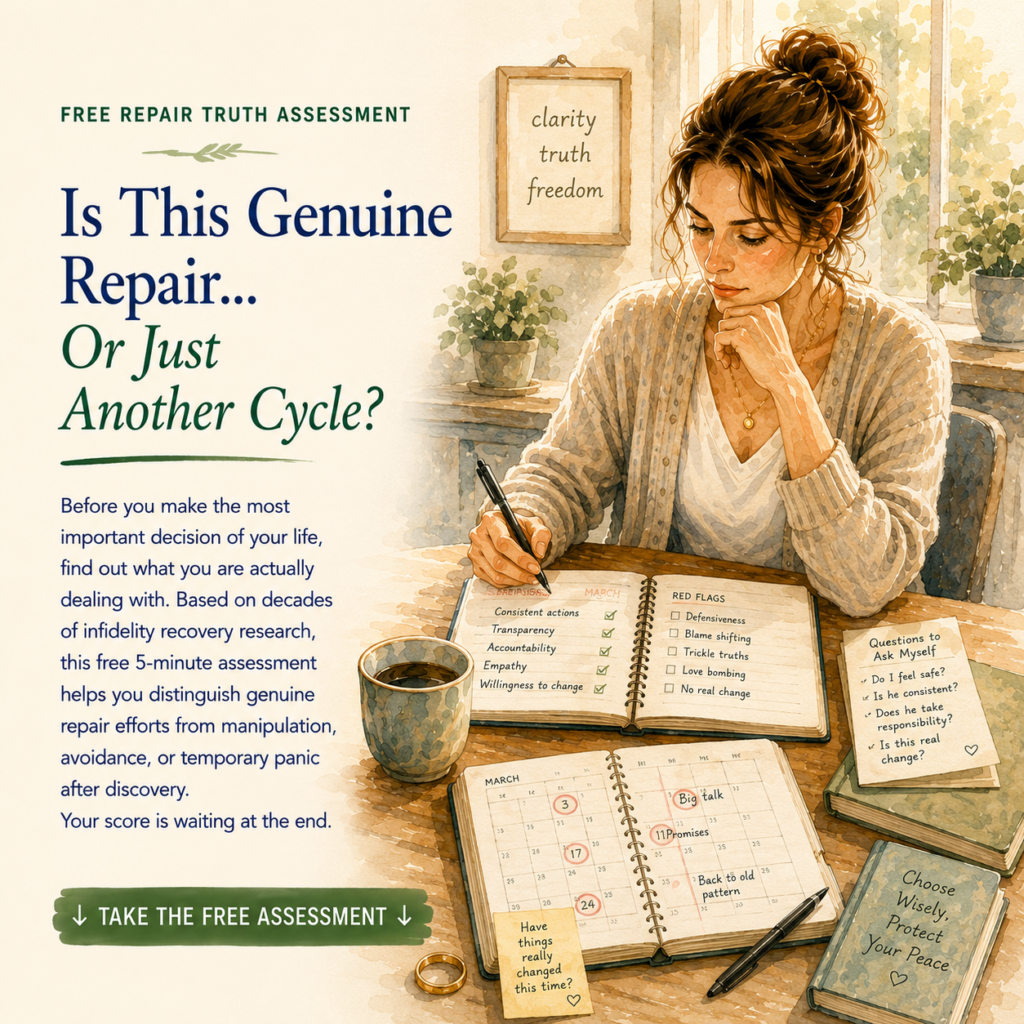
None of this is designed to make the decision for you, and you should be wary of anything that claims to. What a structured framework can do is give your thinking brain an organised way to evaluate what your nervous system may already be registering in fragments, the inconsistencies you’ve half-noticed, the apologies that felt slightly off, the moments of genuine accountability that stood out because they were rare or because they were exactly what you needed.
Whichever way this resolves, staying or going, the goal is the same: that you arrive at the decision having actually looked at the evidence clearly, rather than having the decision made for you by exhaustion, pressure, or the simple passage of time.
If you want the complete twenty-three point assessment behind this framework, along with a guided decision matrix for the specific scenario you’re in, Should I Stay or Should I Go walks through the full research-backed evaluation, step by step, at whatever pace you need.
With you in this, S.J. Howe
FAQ
Q. How long should I take before making a decision?
There’s no universal timeline, and anyone offering you a specific number of weeks is guessing. What matters more than speed is whether you’re evaluating an actual pattern over time, rather than reacting to a single recent moment in either direction.
Q. What if my partner shows some red flags and some repair flags at the same time?
This is common, and a single red flag alongside several repair flags doesn’t automatically disqualify the possibility of repair. The pattern across the whole picture matters more than any one indicator.
Q. Is it possible to stay and still protect myself if things don’t improve?
Yes. Many people document their situation and watch for sustained patterns over time precisely so they can make a clear-eyed decision later, whether that ends in staying or leaving, rather than committing fully in either direction before they have enough information.
Q. What if I already know my answer but I’m scared to act on it?
That’s a different and important situation worth naming honestly. A framework for evaluating uncertainty isn’t the same tool you need if you’ve already reached clarity and the barrier now is fear or logistics rather than not knowing.
Q. Does wanting to stay after an affair mean I’m not respecting myself?
No. Choosing to evaluate whether genuine repair is possible isn’t the same as accepting mistreatment. Self-respect and a considered decision to stay can coexist, provided the decision is based on a clear-eyed look at the actual pattern, not on hope alone.