The Lighthouse Protocol
No-Contact Built on Structure,
Not Willpower.
The complete system for building a boundary that makes contact technically impossible — not just unlikely. The Digital Fortress, the 47-Loophole Matrix, the Accountability Architecture, the Relapse Protocol, and the Partner Presentation Playbook.
🎧 Listen to a sample from the course
One payment. Instant access.
All 7 parts of the system included
Yes, I want The Lighthouse Protocol →Secure checkout via Stripe. 30-day money-back guarantee.
Does this sound familiar?
You’ve made the decision to end contact.
You just want the boundary to hold this time.
No-contact rarely fails because of weak intentions — almost everyone who makes this decision means it. It’s just that intentions alone aren’t quite a system yet. Any channel left technically open tends to get used eventually, deliberately or by accident.
You blocked them on one platform, and a message found its way through a different one you hadn’t thought of yet. The boundary moved rather than closed.
You’ve made this decision more than once, and each time it held for a while before a small gap let contact back in — a shared friend, a shared app, a quieter moment of resolve.
Your partner is still building trust in the boundary, because they’ve seen it tested before — and right now the only proof you can offer is your word.
When contact happened — intentional or accidental — there wasn’t yet a clear plan for what to do in that first hour. A plan would have made it much easier to recover from quickly.
You’re spending energy staying vigilant rather than healing — when what the boundary is actually meant to give you both is real safety and space to move forward.
The Lighthouse Position
Willpower has its limits.
Structure doesn’t need to be remembered.
The core insight of the Lighthouse Protocol is this: no-contact works best not as a decision you make once, but as a system you build once. The difference shows up exactly when willpower is at its lowest — which is usually when contact feels most tempting.
A decision relies on remembering it under pressure. A system holds steady on its own. When every channel is technically closed, when a written accountability structure is in place with pre-agreed responses, and when a relapse plan already exists before you need it, the boundary doesn’t depend on making the perfect choice in a hard moment. It depends on the architecture you’ve already built.
The Lighthouse Position describes the role of the betrayed partner in this system: not the Enforcer who monitors and interrogates, but the Lighthouse — informed by the system, ready with a calm, pre-agreed response if something is flagged, without needing to stand guard every moment. This is the position that lets both partners stop managing the boundary day to day and start genuinely healing.
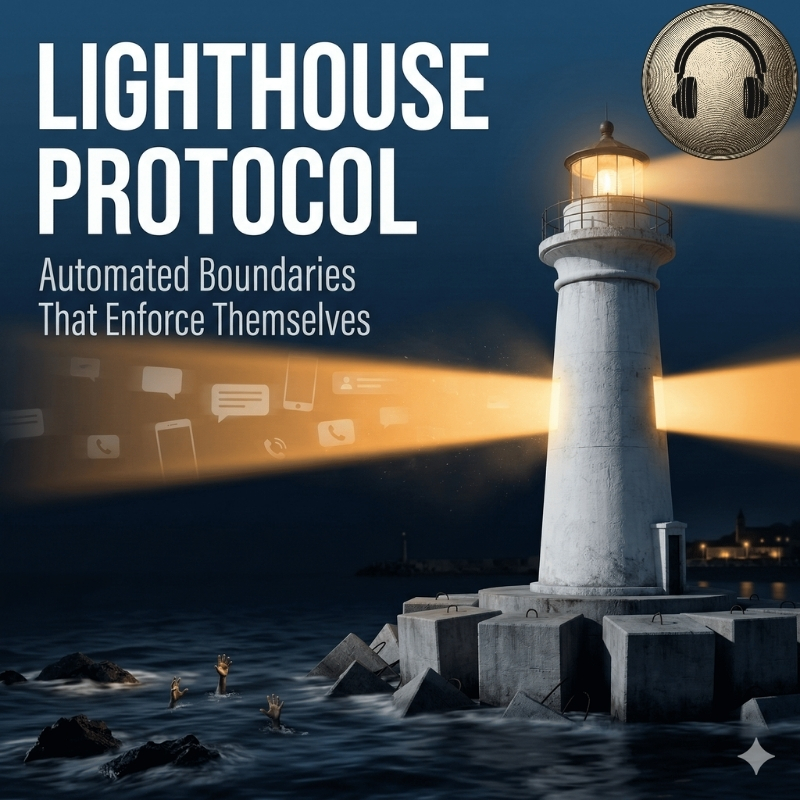
Everything inside the course
7 Parts. One Complete System.
Nothing left out.
The core framework, the 23-point Digital Fortress, the accountability architecture, the relapse protocol, the partner playbook, the 47-loophole matrix, and the top 10 loophole closer. All unlocked immediately.
Part 1 — Core Audio
The Lighthouse Protocol
The complete 45-minute framework. Why structure outlasts willpower. The Lighthouse Position vs the Enforcer Position. How to build a boundary that makes contact technically unlikely to the point of impossible — and gives both partners what the boundary is actually meant to create: genuine safety and room to heal.
45-minute audio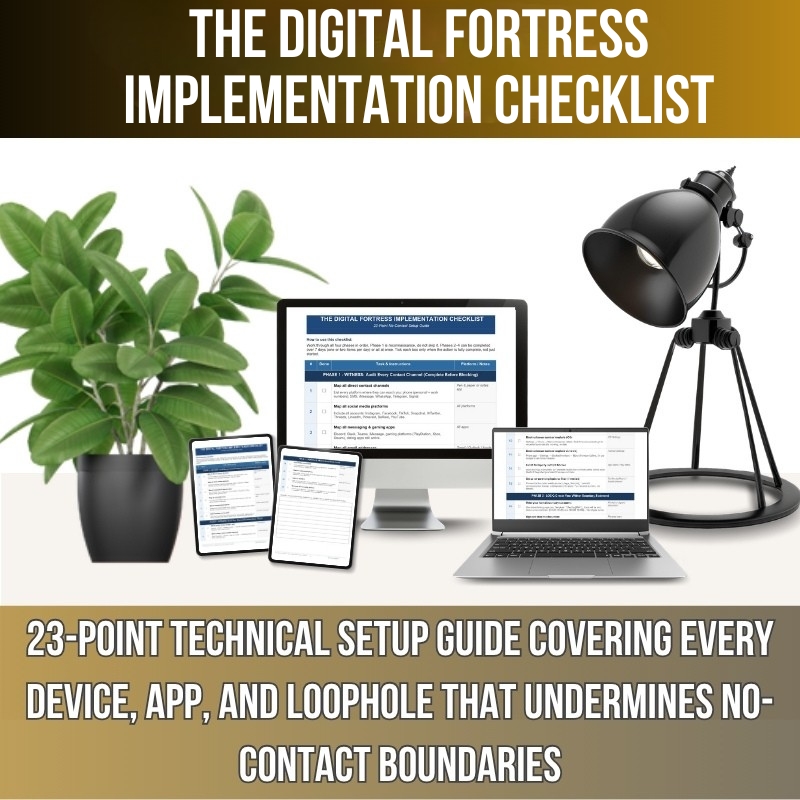
Part 2 — Setup Checklist
The Digital Fortress Implementation Checklist
23-point no-contact setup guide across 4 phases. Phase 1: Witness — audit every contact channel before blocking anything. Phase 2: Automate — block every channel in the right sequence. Phase 3: Lock — write your formal boundary statement using clear, absolute language. Phase 4: Lighthouse — monthly maintenance checks so the system stays strong over time.
PDF + download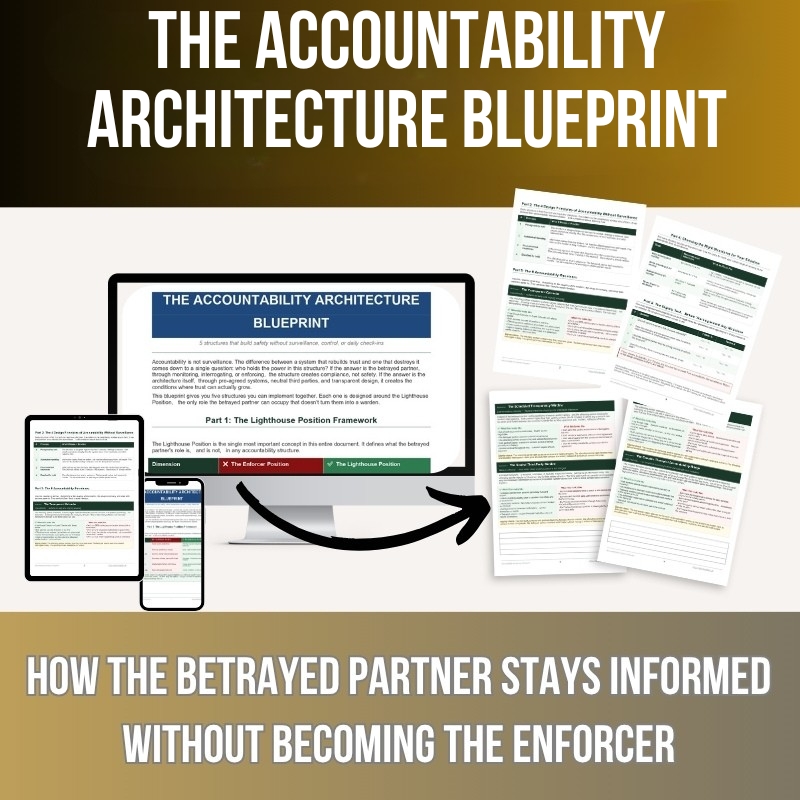
Part 3 — Accountability
The Accountability Architecture Blueprint
5 accountability structures built on the Lighthouse Position — the Transparent Calendar, the Scheduled Transparency Window, the Trusted Third-Party Monitor, the Digital Verification System, and the Structured Check-In Protocol. Each designed so information flows from the system itself, not from daily questioning. Pre-agreed by both partners. Automated reporting. Pre-committed responses.
PDF + download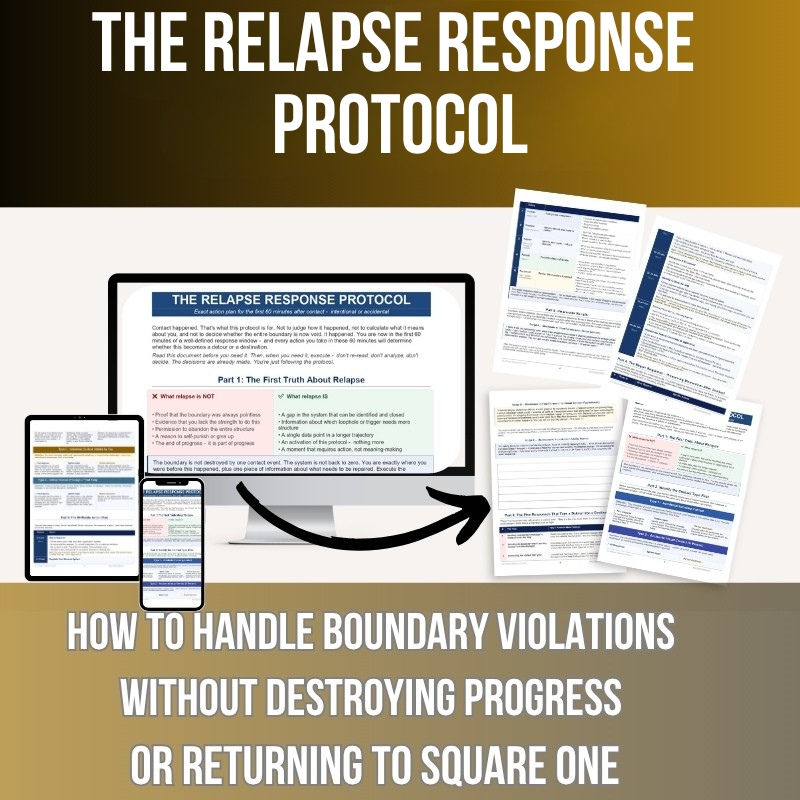
Part 4 — Relapse Protocol
The Relapse Response Protocol
A clear 60-minute action plan for the first hour after contact — intentional or accidental. Four contact types (Accidental Incoming, Accidental In-Person, Intentional, Indirect via Third Party) with a calibrated response for each. The 30-minute and 60-minute action steps. Disclosure scripts for the partner. The reframe at the heart of it: a relapse is a detour, not a destination. Worth reading before you ever need it.
PDF + download
Part 5 — Partner Presentation
The Partner Presentation Playbook
A 4-part opening structure and 7 word-for-word scripts for introducing the Lighthouse Protocol system to your partner. 7 versions for different starting points: starting fresh, after previous attempts, when they’re hesitant, when trust is still low, when they’re actively monitoring, when they want to help design it, and when the relationship’s direction is still undecided. The reframe that changes the conversation — from “I’m proving I’m not cheating” to “we’re building something that makes this question permanently unnecessary.”
PDF + download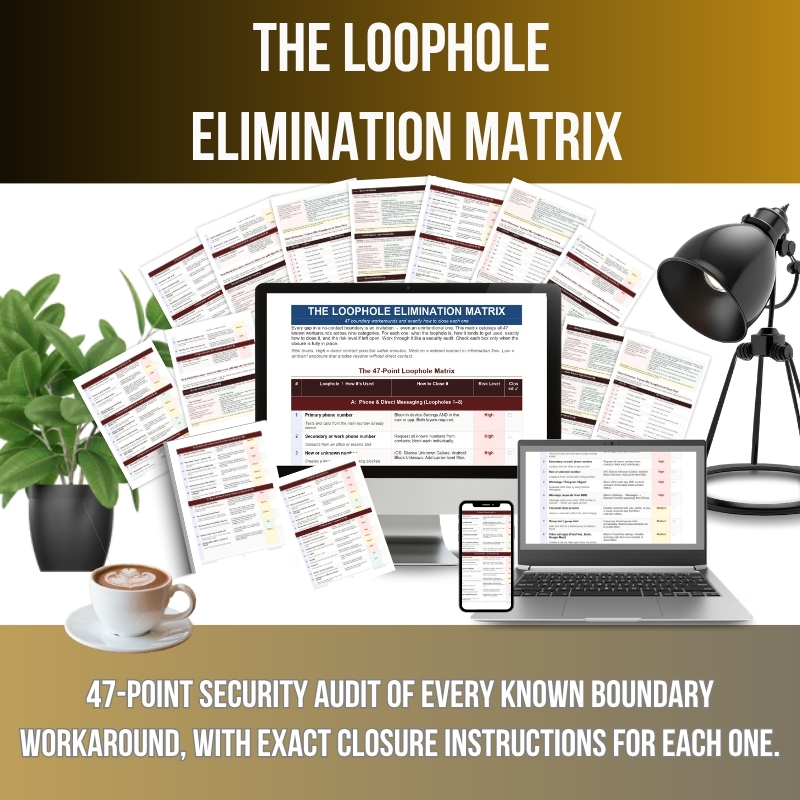
Part 6 — Security Audit
The Loophole Elimination Matrix
All 47 known boundary workarounds across 9 categories: Phone and Messaging, Email, Social Media, Professional and Networking, Physical and Location, Shared Digital Spaces, Third-Party Relay, Legal and Financial Channels, and Timing and Circumstance. For each: what the loophole is, how it gets used, exactly how to close it, and the risk level if left open. Work through it like a security audit.
PDF + download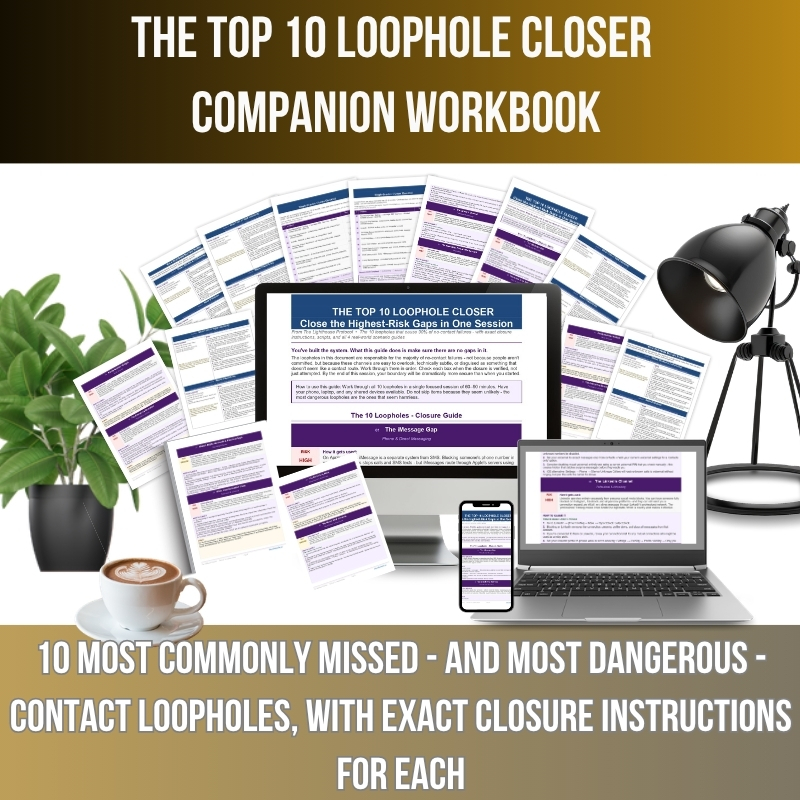
Part 7 — Quick-Close Guide
The Top 10 Loophole Closer
The 10 loopholes behind most no-contact setbacks — with step-by-step closure instructions for each, the time required to close it, and 4 real-world scenario guides. The iMessage Gap, Voicemail Drop Services, the LinkedIn Channel, Secondary Account Workarounds, Shared Location Services, and 5 more. Close the highest-priority gaps in one 60 to 90 minute session.
PDF + downloadWhat it is worth
Everything. One Payment.
Nothing held back.
Secure checkout. Instant access. 30-day money-back guarantee.
What others say
Real results from real people.
“I had ended contact four times before this. Each time it held for a few weeks and then something found its way through — a LinkedIn message, a mutual friend, a shared playlist notification. The Digital Fortress checklist showed me exactly which channels I had missed every single time. I closed 14 gaps in one session. That was eight months ago. The structure has not been tested once since then because there is nothing left to test.”
Rachel D.
Affair recovery, no-contact with affair partner, relationship rebuilt
“The Partner Presentation Playbook changed the entire conversation. Every time I tried to talk about the system before, it turned into an argument about trust. Script 2 — the one for after previous failed attempts — gave me the exact language to shift the frame from ‘I promise this time’ to ‘let’s build something that doesn’t need a promise.’ She asked to go through the checklist with me. That conversation was the first time we both felt like we were building something instead of just surviving something.”
James H.
Affair recovery, relationship in reconciliation, 14 months post-discovery
Questions
Everything you need to know.
Yes. All 7 parts are unlocked the moment your payment is confirmed. Start with Part 1 and the Digital Fortress checklist today.
Both — and ideally both together. Parts 1 through 4 are primarily for the person building the no-contact boundary: the Digital Fortress, the Accountability Architecture, and the Relapse Protocol. Part 5 (the Partner Presentation Playbook) is specifically for introducing the system to the betrayed partner and building it collaboratively. The accountability structures in Part 3 are designed for both partners to agree on together.
The Digital Fortress checklist and the Loophole Matrix both include provisions for situations where some contact can’t be fully avoided. The principle is to route any necessary communication through a designated third party or a structured logistics-only channel — which removes direct contact while still covering what the situation genuinely requires. The Matrix includes specific guidance for workplace contact (Loopholes 23 to 28) and shared parenting logistics (Loopholes 39 to 42).
Not at all. Part 4 of the course — the Relapse Response Protocol — is specifically for this situation. The protocol helps you identify the type of contact that occurred, gives you clear actions for the first 60 minutes, identifies which loophole was used, closes it, and includes a disclosure script for the partner. The reframe at the core of the protocol is that a relapse is a detour, not a destination. One contact event doesn’t end the boundary — it points to a gap, and this protocol closes that gap and brings the boundary back to full strength.
30-day money-back guarantee. Email products@aftertheaffairhub.com within 30 days of purchase for a full refund. No lengthy process.
Blocking one number is a decision. The Lighthouse Protocol is a system. The difference shows up exactly when willpower is at its lowest — which is usually when contact feels most tempting. A decision relies on making the right choice under pressure. A system holds steady without needing that. Across the 47 documented loopholes, there are many ways a single block can be worked around. The protocol closes all of them in one structured process.
You’ve already made the decision.
This gives it somewhere steady to stand.
Intentions are a strong starting point — structure is what makes them last. Any channel left technically open tends to get used eventually. The Lighthouse Protocol closes every channel with a clear, verified step and gives both partners the architecture that makes this question quietly unnecessary going forward. Seven parts. One payment.
All 7 Parts included: $27 one-time payment
Get Instant Access for $27 →Secure checkout via Stripe. Instant access on purchase.
30-day money-back guarantee. Questions: products@aftertheaffairhub.com