co-parenting red flags
Your Evidence Is Real.
It Just Needs the Right Structure.
The Pattern Archive Method is a strategic documentation system that turns your existing evidence into the kind of clear, organised record that courts, evaluators, and attorneys can actually act on. Not legal advice. A practical method for making a pattern visible.
🎧 Listen to a sample from the course
One payment. Instant access.
All 7 parts of the system included
Yes, I want The Pattern Archive Method →Secure checkout via Stripe. 30-day money-back guarantee. Not legal advice.
Does this sound familiar?
You have the screenshots.
You just want them to be heard.
This usually isn’t about whether your evidence is true. It’s about how it’s organised. Most of us document the way memory naturally works — chronologically, emotionally, incident by incident — and courts are simply trained to read evidence differently.
You have hundreds of screenshots that feel clear and significant to you, and can look like separate, unconnected moments to someone reviewing them one at a time.
You’ve told professionals what’s happening and had it noted without much action, because they’re looking for a documented pattern, not an account of single incidents.
Your co-parent comes across as calm and reasonable in formal settings, even while things look different in private — and it’s hard to know how to make that gap visible to the people who matter.
The documentation itself feels tiring — re-reading old logs, going back over each incident, trying to find an order that makes sense of it all.
Your attorney has told you that you have evidence of conflict but not yet evidence of a pattern — and the gap between those two things isn’t always obvious.
The Rule of Three
One incident is an accident.
Two incidents are a dispute.
Three become a pattern.
That distinction between an incident and a pattern is really the whole game. The same screenshots, the same messages, the same incidents, organised differently, tend to land very differently with professionals. This isn’t about gathering more evidence. It’s about structuring what you already have so it’s easier for courts to read it the way they’re trained to.
The Pattern Archive Method walks you through sorting each incident in your folder into one of 7 Manipulation Categories, identifying the three strongest pattern categories you’ve already documented, and presenting them so that repetition, timing, and intent become visible on the page — not just something you’ve felt for a long time.
The Plausible Deniability Decoder speaks directly to one of the trickiest situations: behaviour that looks cooperative in public while something quite different happens in private. It’s the pattern most parents find hardest to put into words, and the method was built specifically to help with it.
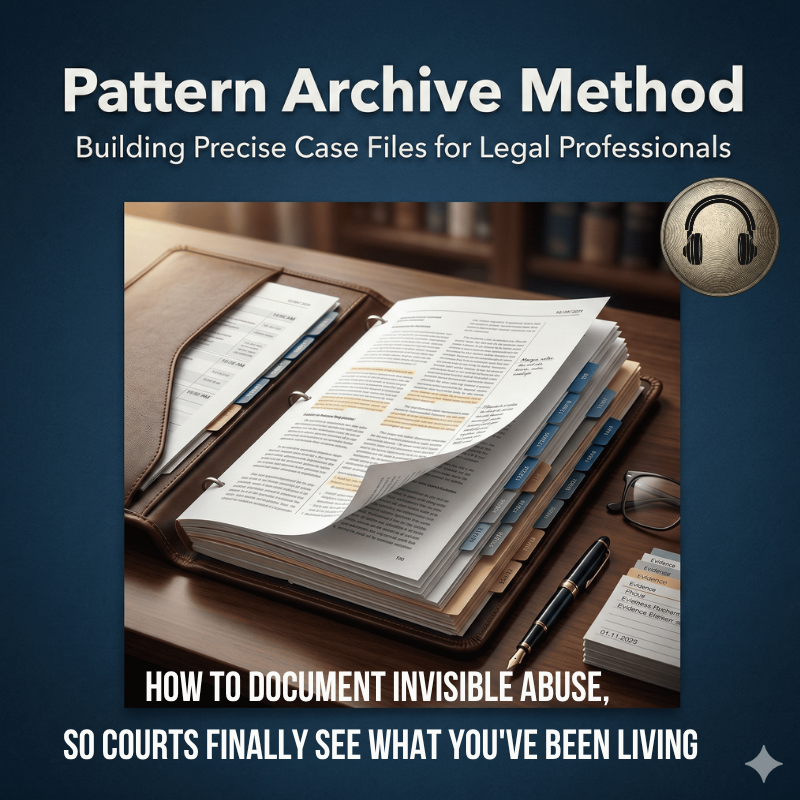
Everything inside the course
7 Parts. One Complete System.
Nothing left out.
The core audio, the 23-pattern checklist, the court-ready templates, the timing analyzer, the companion workbook, the justification script, and the quick-start decoder. All unlocked immediately.
Part 1 — Core Audio
The Pattern Archive Method
The incident-vs-pattern distinction, the Rule of Three, the 7 Manipulation Categories, and the Plausible Deniability Decoder. A shift in how you read everything already sitting in your folder.
45-minute audio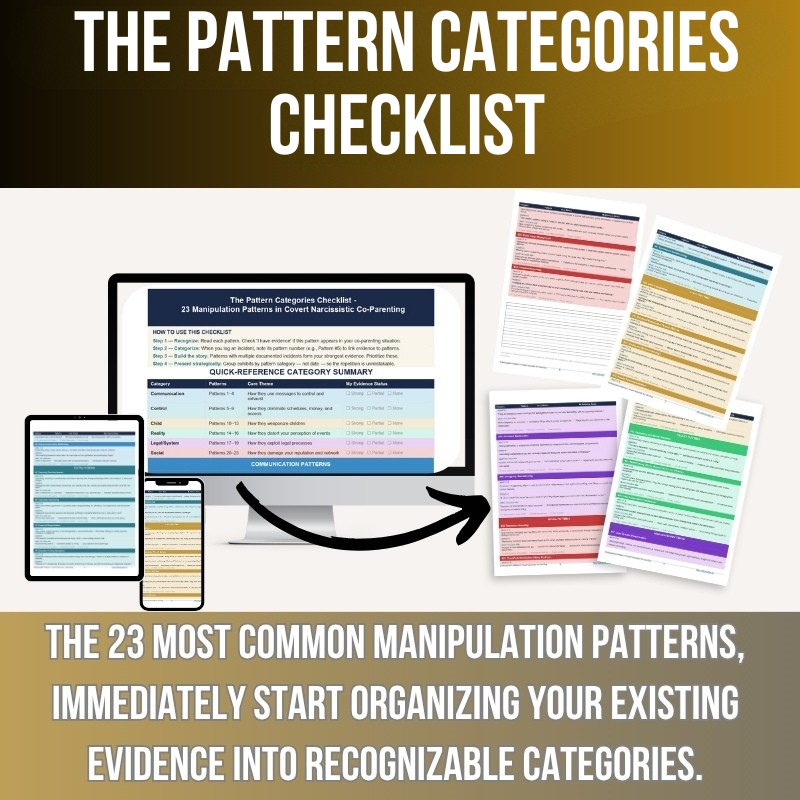
Part 2 — Pattern Reference
The Pattern Categories Checklist
23 specific behaviours across 6 categories — Communication, Control, Child, Reality, Legal/System, and Social — with a description, an example, detection signals, and evidence status for each.
PDF + download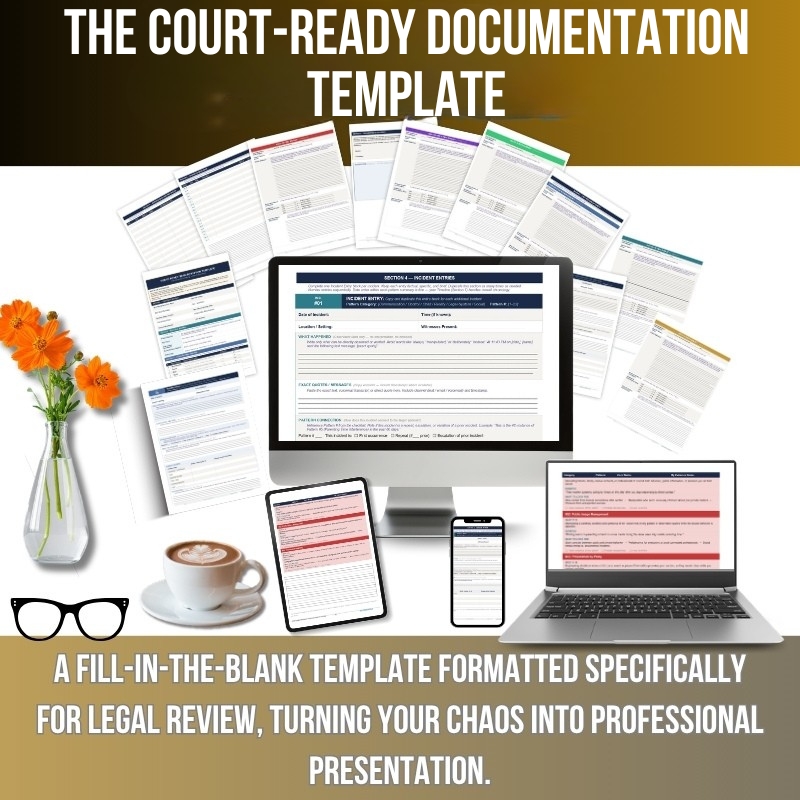
Part 3 — Documentation Templates
The Court-Ready Documentation Template
Fill-in-the-blank templates for 8 pattern types. Each ends in a clear, court-ready one-sentence summary your attorney can use. Best completed within an hour of any incident while the details are still fresh.
PDF + download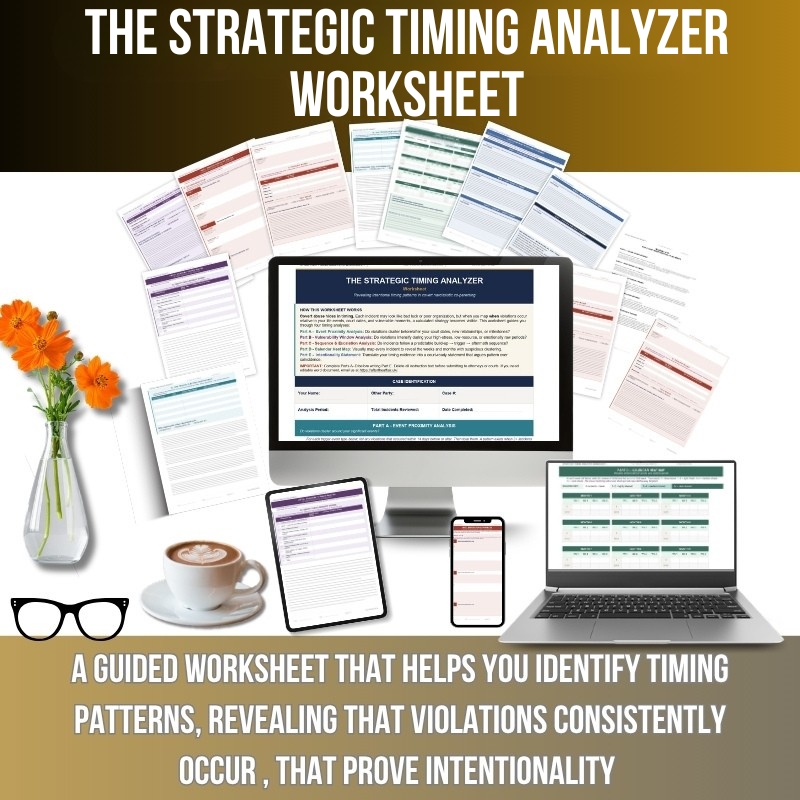
Part 4 — Timing Analysis
The Strategic Timing Analyzer
Event proximity analysis, vulnerability window mapping, escalation sequence analysis, a calendar heat map, and a court-ready statement that helps argue pattern over coincidence.
PDF + download
Part 5 — Companion Workbook
The Pattern Archive Companion Workbook
Timestamped to the audio. 8 sections completed alongside Part 1, so your first real archive entries are built before the audio ends. Print it before you press play.
PDF + download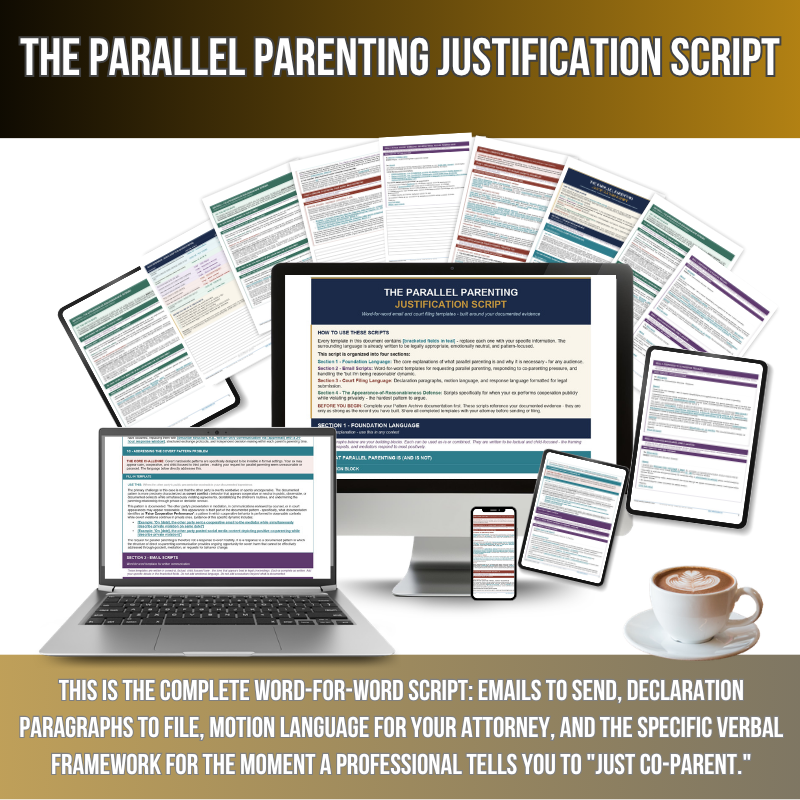
Part 6 — Legal Scripts
The Parallel Parenting Justification Script
Foundation language, email templates, court filing language, and the Appearance-of-Reasonableness Defence — for any context where you need to explain or support a request, built around your own documented evidence.
PDF + download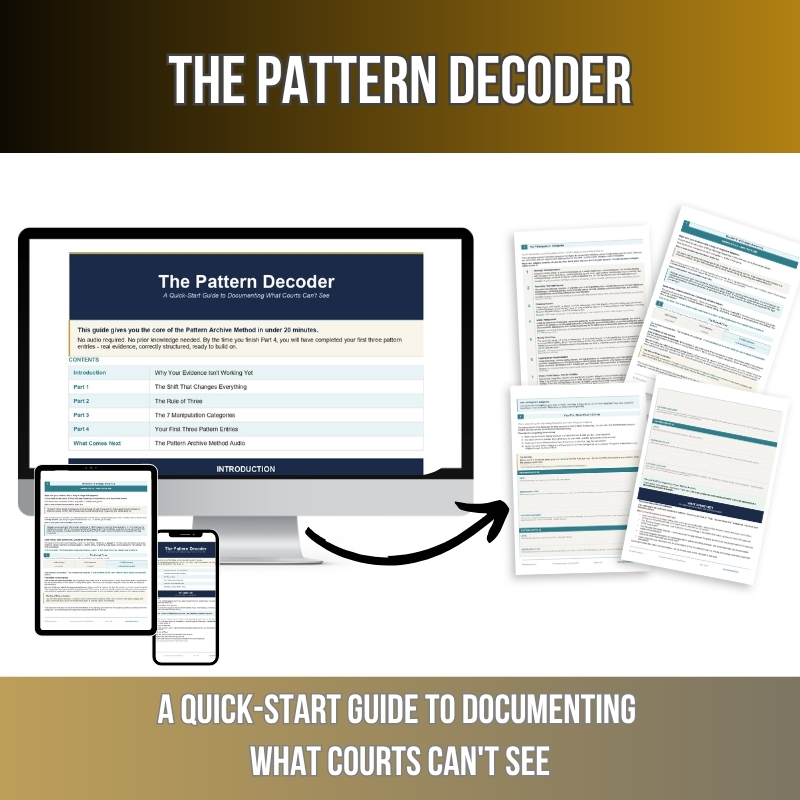
Part 7 — Quick-Start Guide
The Pattern Decoder Guide
The full method in under 20 minutes, with your first three pattern entries completed by the end. Useful for the moments when something has just happened and you want to document it while it’s fresh.
PDF + downloadWhat it is worth
Everything. One Payment.
Nothing held back.
Secure checkout. Instant access. 30-day money-back guarantee. Not legal advice.
What others say
Real results from real co-parents.
“I had screenshots going back two years. My solicitor told me I had evidence of conflict but not evidence of a pattern. Within a week of applying the method I had reorganised my existing documentation into four clear pattern categories with three or more incidents each. My solicitor’s response at our next appointment was the first time I felt like someone finally understood what I had been living.”
Anna S.
High-conflict co-parenting, custody proceedings ongoing, two children
“The Strategic Timing Analyzer was the piece that made everything visible. I knew the violations clustered around my court dates — I had felt it for months. The worksheet mapped 11 violations in the 14 days before four consecutive hearings. I showed that to my attorney and watched her expression change. That document is now part of my case bundle.”
Mark T.
Parallel parenting arrangement sought, daughter aged 7, proceedings at CAFCASS stage
Questions
Everything you need to know.
No. This is strategic guidance on documentation, communication, and positioning. It is not a substitute for qualified legal advice in your jurisdiction. Everything in the course is designed to support and strengthen your legal position when working with an attorney — not replace one.
Yes. All 7 parts are unlocked the moment your payment is confirmed. Print the Companion Workbook before you press play on Part 1.
Parents who feel most prepared in co-parenting disputes are usually the ones who started documenting well before they needed to, rather than scrambling to assemble a record at the last moment. The Pattern Archive tends to be most valuable when started ahead of a crisis, but it’s useful at any stage.
Yes — this is exactly the situation the Plausible Deniability Decoder in Part 1 and the Appearance-of-Reasonableness Defence in Part 6 are built for. Patterns that stay invisible in formal settings just need a specific documentation structure to become visible, and that’s what the method provides.
30-day money-back guarantee. Email products@aftertheaffairhub.com within 30 days for a full refund. No lengthy process.
A journal records what happened and how you felt about it. The Pattern Archive records observable facts, sorts them into recognisable pattern categories, maps them against the dates of legal events, and produces a court-ready one-sentence summary for each incident. The same events, organised this way, tend to land very differently with professionals.
The evidence is real.
It just needs the right structure.
Courts tend to respond to patterns more readily than individual incidents. The Pattern Archive Method gives your existing evidence the structure that makes the pattern visible — the Rule of Three, the 7 categories, the timing analysis, and the court-ready templates. Seven parts. One payment.
All 7 Parts included: $27 one-time payment
Get Instant Access for $27 →Secure checkout via Stripe. Instant access on purchase. 30-day money-back guarantee.
Not legal advice. products@aftertheaffairhub.com