Table of Contents
The Psychology of Repeat Betrayal: A Deep Dive
Serial betrayal is one of the most confusing experiences a person can face in a relationship, because it breaks a rule that most of us hold as true: that genuine remorse prevents repetition.
It does not. And understanding why is the starting point for everything else.
Serial betrayal is not caused by a lack of love. In the majority of cases the person with the pattern loves their partner. The love is real. The remorse after each betrayal is real. The promises are meant sincerely at the time they are made. And then the betrayal happens again anyway.
This is what separates serial betrayal from a single catastrophic decision, and what makes it so disorienting for both people involved.
The research-supported explanation is neurological rather than moral. Repeated betrayal, particularly when it involves secrecy, creates what can be described as a Corrupted Reward System: a conditioned neural pathway that associates the betrayal behaviour with relief, stimulation, or escape from emotional pain. Once this pathway is established and reinforced, willpower alone cannot reliably override it, for the same reason that willpower alone cannot reliably override addiction.
The specific causes most commonly identified in high-repetition betrayal patterns include:
Compartmentalisation as a coping mechanism. Some people have an unusually high capacity to hold conflicting realities without full emotional integration. The betrayal and the relationship exist in separate compartments, and the person can move between them without the discomfort that would function as a natural brake.
Attachment dysregulation. People with anxious or disorganised attachment styles may seek the intensity of secret connection as a way of managing underlying anxiety, without consciously connecting that behaviour to the harm it causes.
The Attachment-Accountability Loop is broken. In most people, loving someone creates an automatic aversion to causing that person harm. When this loop is intact, it works like flinching from a hot stove. In some people, through early experience or conditioning, this loop is structurally compromised. The love is present but the automatic brake is not.
Avoidance of intimacy through parallel relationships. Some people use outside connection to manage vulnerability and avoid the full exposure of being truly known in a committed relationship. This is rarely conscious.
Consequences that do not register at the neurological level. When someone with a Corrupted Reward System faces consequences, they experience genuine distress. But the distress does not interrupt the neural pathway that drives the behaviour. It creates remorse without interruption.
None of these causes are excuses. Understanding the mechanism does not remove accountability. It changes the intervention required.
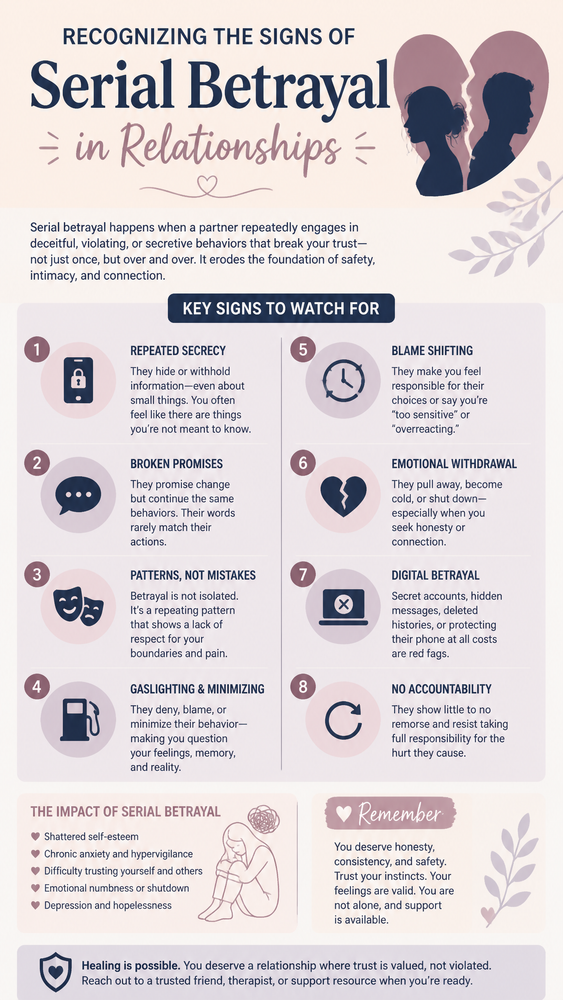
Understanding Serial Betrayal Patterns in Relationships
A single betrayal and a pattern of serial betrayal require completely different responses. Treating a pattern as if it were a one-time incident is one of the most costly mistakes a person can make, because it applies the wrong tools to the wrong problem.
The defining features of a serial betrayal pattern are:
The betrayal recurs despite genuine remorse. This is the most important marker. If someone is sorry and means it and the behaviour repeats, you are not dealing with a character failure. You are dealing with a structural loop that genuine intention cannot reliably interrupt.
The person cannot fully explain why. When pressed for a real explanation that accounts for the pattern rather than the individual incident, they do not have a satisfying answer. This is not evasion. It reflects the fact that the behaviour is not fully controlled by the conscious, reasoning mind.
Willpower-based interventions have not worked. Decisions made with complete sincerity have not held. Therapy that focused on communication and connection helped the relationship but did not interrupt the pattern.
A specific post-discovery window appears. After each discovery, there is typically a period of genuine improvement: increased presence, openness, effort, communication. Then, gradually, the baseline quietly returns. This window is not performance. It reflects a temporary disruption of the pattern followed by the pattern reasserting itself.
Secrecy is central to the behaviour. The concealment is not incidental. For people with a Corrupted Reward System, the secrecy itself is often part of the neurological reward. Removing the secrecy, through radical transparency, is therefore not just a trust-rebuilding gesture. It is a structural intervention.
Understanding whether you are looking at a pattern or a single incident is not an academic question. It determines everything about what needs to happen next.
What Are the Signs of Serial Betrayal?
The signs of serial betrayal are often subtle early in the cycle and easier to identify in retrospect. The most reliable signs fall into two categories: behavioural patterns and response patterns.
Behavioural signs of serial betrayal:
Trickle-truthing across multiple discoveries. Each time new information emerges, the full picture turns out to be larger than what was admitted. The scope of the betrayal keeps expanding as evidence accumulates.
A recurring improvement window followed by a quiet revert. The relationship becomes noticeably better after discovery. Effort, openness, and presence all increase. Then, over weeks or months, the improvements fade and the environment before the next incident quietly re-establishes itself.
Protective secrecy around specific channels or contacts. A name, a platform, or a device that was mentioned naturally in conversation suddenly disappears from it. This absence of previously present information is often more significant than the presence of suspicious evidence.
A pattern across time, not a single event. Multiple incidents, whether identical or in different forms, that share the underlying structure of secret contact and concealment.
Response signs, observed after discovery:
Genuine remorse that does not interrupt repetition. The person is not performing remorse. The remorse is real. And the pattern continues anyway. This combination is the clearest signal that you are dealing with a structural loop rather than a character choice.
Inability to explain the pattern at the level of cause. They can explain the individual incident. They cannot explain why it keeps happening. This is not deflection. It is an accurate reflection of the fact that the pattern is not fully accessible to the conscious mind.
Resistance to structural accountability. Transparent systems, consequence structures, and third-party accountability feel intrusive or excessive. This is not evidence of guilt. It may reflect a genuine lack of understanding that the situation requires architecture rather than willpower.
If you are unsure whether what you are seeing is a pattern, the Serial Betrayal Diagnostic gives you ten questions that identify the specific markers of a broken Attachment-Accountability Loop. It takes three minutes and provides a scored result.
Uncovering the Cycle of Betrayal: What You Need to Know
The cycle of serial betrayal has a specific structure. Recognising it is important because it prevents two of the most common and costly errors: deciding too quickly that the pattern is permanent, and deciding too quickly that the pattern has been broken.
The cycle typically unfolds in four phases:
Phase 1: Stability with drift. The relationship functions. Both people are present. Under the surface, the person with the pattern begins to experience the internal conditions, often stress, anxiety, or intimacy avoidance, that precede the behaviour. This phase is often invisible to both parties.
Phase 2: The behaviour and concealment. The betrayal occurs. The concealment structures that make it possible are active. From the outside, the relationship may appear unchanged.
Phase 3: Discovery and peak effort. The betrayal is discovered. The response is genuine distress, genuine remorse, and a genuine increase in relationship investment. This is not performance. It is a real response to real consequences. Behaviour improves measurably.
Phase 4: The quiet revert. Gradually, without conscious decision, the improvement fades. The internal conditions that preceded Phase 1 reassemble. The environment for the next cycle re-establishes itself.
The critical thing to understand about this cycle is that it is not driven by insufficient love or insufficient desire to change. It is driven by a neurological pattern that continues to operate below the level of conscious intention. Breaking it requires intervening at the structural level, not the motivational level.
For the partner, understanding the cycle does one specific thing: it allows you to evaluate evidence over time rather than making permanent decisions based on a single phase. A commitment made sincerely in Phase 3 is not a lie. It is also not a reliable predictor of Phase 4 behaviour without structural change.
The Shocking Truth Behind Repeat Betrayals
The truth that most people find hardest to accept is this: the person who keeps betraying you may genuinely love you.
Not might. May. Often does.
This is the element that makes serial betrayal so much more disorienting than a single betrayal, and so much harder to respond to. With a single betrayal, the question is whether you can forgive a choice. With serial betrayal, you are facing something that does not respond to forgiveness in the expected way.
The second truth that is equally important and equally difficult: genuine remorse is not sufficient to interrupt a neurological pattern.
The promises mean something. The resolve is real in the moment it is expressed. And it is not enough, because willpower applied to a structural loop eventually gives way. Every time. Not because the person is weak, but because the tool does not match the problem.
The third truth: this is not treated the same way as a single betrayal.
Couples therapy that focuses on communication, connection, and understanding the circumstances of the affair is the appropriate intervention for a single catastrophic decision. For a pattern, something different is required: a structural accountability system, a transparent architecture that removes the conditions in which the pattern operates, and a neurological interruption of the reward pathway rather than a motivational one.
This is what The Pattern Interrupt is built around. Not trying harder. Not understanding each other better. Changing the structure so the pattern cannot reassemble itself.
Breaking the Cycle of Serial Betrayal: Strategies
Breaking the cycle of serial betrayal requires three things operating simultaneously. Any single one of them, applied without the other two, is insufficient.
1. A structural accountability system, not a willpower-based one.
The person with the pattern must accept a framework that removes the structural conditions in which the behaviour operates. This typically includes a radical transparency system across all channels of potential contact, a consequence circle of two or three people who are briefed and will respond if the pattern reactivates, and a behavioural baseline that is documented and observable.
This is not surveillance. It is architecture. The difference is that surveillance is imposed externally and resented. Architecture is agreed to voluntarily and maintained internally.
2. A neurological interruption of the reward pathway.
The Corrupted Reward System cannot be addressed through motivation alone. It requires consistent exposure to a replacement reward pathway: genuine intimacy, radical transparency, and the emotional experience of being fully known rather than hidden. This is not a natural process. It requires deliberate structure over a sustained period, typically a minimum of 90 days for the new pathway to begin to establish itself.
3. Early warning recognition for the partner.
The cycle has observable early warning signs that appear three to six weeks before the next incident, if you know what to look for. A slight increase in irritability. A decrease in proactive communication. A return to the internal withdrawal that characterises Phase 1. Partners who learn to recognise these markers can name them early and interrupt the cycle before it progresses to Phase 2.
The Pattern Interrupt course covers all three of these components, including the Accountability Architecture Blueprint, the 7-day Dopamine Detox Scripts for neurological pathway replacement, and the Relapse Recognition Matrix that provides a 27-point weekly assessment with four alert levels.
If you are the person with the pattern, the same architecture applies. You need structure, not more resolve.
Get instant access to The Pattern Interrupt here.
How Do You Heal from Serial Betrayal?
Healing from serial betrayal, whether you stay in the relationship or leave it, requires a different process from healing from a single betrayal. The specific elements that are different:
The nervous system has been conditioned across multiple cycles. Each discovery and recovery has trained your system to scan constantly for early signs of the next one. This hypervigilance is not anxiety disorder. It is a rational adaptation to a real pattern. The path through it is not reassurance. It is evidence-based trust built across a documented period.
The confusion is structural, not emotional. The question “why does this keep happening if they love me?” does not have a satisfying emotional answer. It has a neurological one. Understanding the Attachment-Accountability Loop resolves this confusion in a way that no amount of reassurance can, because it addresses the actual mechanism rather than the symptom.
The decision requires different information. Whether to stay or leave after serial betrayal is not a question about forgiveness. It is a question about structural change. The relevant evidence is not how the person feels about you or how remorseful they are. It is whether the accountability architecture is in place and whether the early warning markers show a genuine pattern interruption.
For the partner who stays: healing means building a 90-day evidence base, learning to distinguish between the post-discovery window and genuine structural change, and maintaining the accountability architecture even when the relationship feels good. It means trusting your observation of consistent behaviour over time rather than trusting the emotional intensity of a moment.
For the partner who leaves: healing means understanding that the pattern was not caused by your insufficiency. The Corrupted Reward System is a structural condition, not a response to what the relationship lacked. Leaving does not mean the relationship failed. It means the required intervention was not accepted or was not sufficient.
For the person with the pattern: healing is possible, but it requires the willingness to accept a level of structural accountability that feels disproportionate to someone who does not fully understand the neurological mechanism. It requires more than good intentions and more than couples therapy. It requires architecture.
Your Next Step
If you recognise any of this in your own situation, the first step is to understand specifically what you are dealing with.
The free Serial Betrayal Diagnostic identifies whether the specific markers of a broken Attachment-Accountability Loop are present in your situation. Ten questions. Three minutes. A scored result that tells you clearly whether you are looking at a pattern or a single incident, and what that distinction means for what comes next.
Take the free diagnostic here.
If you already know you are looking at a pattern and you are ready to address it structurally, The Pattern Interrupt gives you the complete system:
- the Accountability Architecture Blueprint,
- the Dopamine Detox Scripts,
- the Partner’s Emergency Protocol,
- and the Relapse Recognition Matrix.
Get instant access to The Pattern Interrupt ($27).
S.J.Howe writes about the psychological and neurological mechanics of betrayal and recovery at aftertheaffair.uk and aftertheaffairhub.com. For questions: products@aftertheaffairhub.com