Table of Contents
You don’t need a therapist’s vocabulary right now. You need words that get you through the next hour without making things worse. This is what to say when you find out your husband cheated, the exact phrasing for discovery, confrontation, and the First 48 Hours Survival after, not another explainer on grief stages.

Most of what’s online defaults to generic emotional-stage content or forum threads full of “I’m so sorry, sending hugs.” None of it gives you actual lines to say when he’s standing in front of you and you can’t breathe. That’s the gap this piece fills.
The First 5 Minutes: What to Say When You Find Out Your Husband Cheated
The first five minutes aren’t for processing. They’re for survival. Your only job is to get through the moment without saying something you can’t take back, or committing to a plan you haven’t chosen.
You don’t owe him composure. You also don’t owe him a full reaction before you’ve had time to think.
If He’s Standing in Front of You
Say it flat. Don’t dress it up, don’t ask permission to be upset:
- “I know. Don’t talk yet.“
- “I found [what you found]. I’m not doing this conversation right now.”
- “I need you to leave the room for ten minutes.”
These lines do one job: they name the discovery and buy you space. They aren’t the confrontation. That comes later, once you’ve decided how you want to run it.
If You Found Out Through a Text or Screenshot
Finding out through a phone left unlocked or a message that wasn’t meant for you hits differently. You’re often alone with it, with no one to react to yet. Don’t rush to write back.
If he’s in another room or another city, a short line covers you until you’re ready to talk:
- “I saw it. I’m not replying right now.”
- “We need to talk when I’m ready, not when you are.”
Send it or say it, then put the phone down. You don’t need to explain your reasoning yet.
Deciding Whether to Confront That Night
Confronting a cheating spouse the same night feels urgent because shock makes waiting feel like weakness. It isn’t. Waiting a few hours, or until morning, is often the smarter move, not the passive one.
Use this checklist. If any of these apply, wait until morning:
- Kids are in the house and awake. A confrontation that turns loud or tearful isn’t something they should walk in on.
- Either of you has been drinking. Alcohol doesn’t produce honesty. It produces volume and things you’ll both regret.
- You’re past the point of exhaustion. Discovery often lands at night, after a full day, and exhaustion strips your ability to hold your own line.
- You don’t feel physically safe. If there’s any history of aggression, don’t confront alone or at night. Confront in daylight, with a plan to leave if you need to.
None of these conditions mean you’re letting him off the hook. They mean you’re choosing the terms instead of reacting on his timeline.
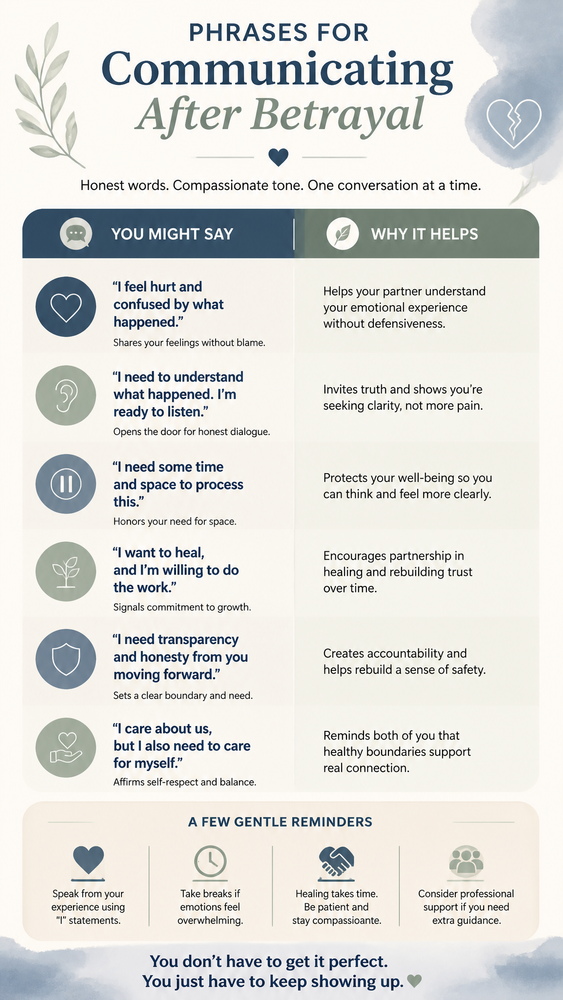
How to Confront a Cheating Spouse Without Losing the Thread
When you do sit down for the real conversation, the goal isn’t resolution. It’s facts and containment. You aren’t trying to fix the marriage in this conversation. You’re trying to find out what happened without letting him rewrite it as it’s happening.
Opening Lines That Don’t Let Him Reframe It
Cheating spouses often try to soften the opening seconds of a confrontation. They minimize, deflect, or turn it around on you before you’ve even asked a question. Don’t let the opening line be his.
- “I’m not here to hear how it happened. I’m here to hear what happened. Start with the facts.”
- “I already know [X]. I want to know what else I don’t know.”
- “Don’t tell me it meant nothing. Tell me what it was.”
Each of these does the same thing: it sets the terms before he can set his own.
Questions to Ask Before He Controls the Narrative
Ask these early, before the conversation drifts into apology or justification:
- “How long has this been going on?”
- “Is it still going on?”
- “Who else knows?”
These are fact-finding questions, not emotional ones. Save the “why” and the “do you love her” questions for later. They rarely get honest answers in the first conversation anyway.
What to Text a Cheating Partner When You Can’t Be in the Room
Sometimes discovery happens when you’re not physically together. He’s traveling, you’re at work, the kids are around and a full conversation isn’t possible yet. Text is a holding tool, not a processing one. It should state facts and boundaries, not feelings.
Try one of these instead of a paragraph explaining how you feel:
- “I know about [X]. We’re talking about this in person, not over text.”
- “Don’t call me right now. I’ll tell you when I’m ready.”
- “I need you to stay somewhere else tonight.”
Short, factual, and non-negotiable. You’re not obligated to narrate your emotional state to someone who just detonated it.
Understanding the pattern is not the same as breaking it
You Can Explain Why This Happened. Can You Explain Why You’re Still Stuck In It?
Most people in affair recovery can narrate their entire situation with total clarity, the timeline, the triggers, the whole story, and still find themselves back in the same spiral by evening. Insight was never the missing piece. This free assessment shows you exactly where the gap actually is.
Take the Free Affair Recovery Clarity Check →A few honest questions · a scored result · 4 minutes · free
The Betrayal Discovery Day Script: What Not to Say (and Why)
Shock produces promises and ultimatums neither side can actually keep. Here’s what tends to backfire on discovery day, and a calmer alternative for each.
“I’ll never trust you again.” It feels true in the moment, but it forecloses a conversation you may not be ready to close. Try: “I don’t trust you right now. What happens next depends on what you do.”
“I want a divorce.“ Said in shock, it can box you into a decision made before you have all the facts. Try: “I don’t know what I want yet. I know I’m not okay.”
“It’s fine, we’ll get through this.” Reassuring him this early skips your own reaction and hands him relief he hasn’t earned. Try: “I’m not saying it’s fine. I’m saying I need time before I decide anything.”
“Tell me everything, I need every detail right now.“ Demanding the full account in the first hour usually means you’re in shock, not in a state to actually absorb it. Try: “I want the full picture, but not tonight. We’ll go through it in stages.”
None of these alternatives protect him. They protect your ability to make decisions later that you actually meant.
After the First Conversation: What Actually Comes Next
Once the first conversation ends, resist the urge to tell everyone or no one on instinct alone. Both are decisions, so make them on purpose. Telling one trusted person can keep you from carrying this completely alone. Telling everyone before you’ve had 48 hours to think can turn a private decision into a public one you can’t walk back.
Write down what he said while it’s fresh: dates, names, what he admitted to. Memory blurs fast under stress, and you may need this later, whether for yourself or for a lawyer.
Handle logistics before anything else: where he’s sleeping tonight, who’s with the kids, whether you’re going to work tomorrow. Decide these as facts, not as symbols of what the marriage means now.
The first 48 hours after discovering an affair aren’t about deciding whether to stay or leave.
They’re about getting through the discovery without losing your footing. S.J. Howe built After the Affair Hub from lived experience with betrayal and separation, working with a counsellor co-author, specifically for that window: the exact moment of discovery, not general grief processing. The counsellor co-author reviewed the frameworks to make sure the exact-words scripts support longer-term processing instead of short-circuiting it.
If you’re in the middle of the 9pm text or the bedtime question you can’t answer honestly, the discovery-day and first-conversation course walks through the next steps in the same word-for-word format as this article. For around $27, it’s built to get you through the next 48 hours, one exact sentence at a time.