Table of Contents
You searched for a parallel parenting plan template because you’re done hoping the other parent will just cooperate. Most of what comes up is a legal-aid PDF written for parents who can still have a civil conversation. That’s not your situation. Generic clauses won’t hold up against someone who looks for loopholes.
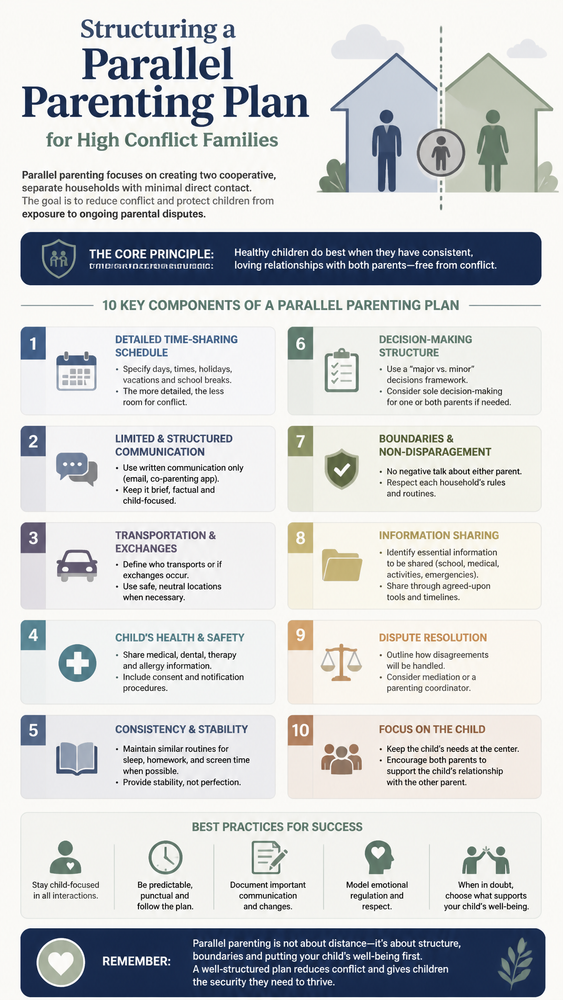
This template comes from a different place. It’s S.J. Howe’s own high-conflict co-parenting arrangement, refined after real handoffs went wrong, not drafted from legal boilerplate. It’s built for exchanges that turn into arguments, texts that turn into ambushes, and an ex who treats every ambiguous clause as an opening.
What a Parallel Parenting Plan Template Actually Needs to Cover
Parallel parenting means each parent operates independently within their own parenting time. There’s no shared decision-making on the small stuff, no joint attendance at pickups, and almost no direct conversation. Contact is limited, scripted, and usually in writing.
That’s the opposite of cooperative co-parenting, where parents coordinate schedules, talk regularly, and present a united front. Cooperative co-parenting works when both adults can separate their feelings about each other from their job as parents. Parallel parenting exists for when they can’t.
Family law and co-parenting counselors draw this line for a reason. Low-contact, high-structure plans cut kids’ exposure to conflict when parents can’t communicate safely. The goal isn’t punishing anyone. It’s removing the moments where conflict has room to happen.
A workable template covers four things: how exchanges happen, how you communicate, who decides what, and how you document it all. Skip any one of these and the plan leaves a gap your ex will find.
Parallel Parenting vs Co-Parenting: Why the Distinction Matters
Generic templates assume both parents want the same outcome and will act in good faith. High-conflict cases don’t have that luxury. A co-parenting template might say “parents will discuss and agree on extracurricular activities.” A parallel parenting plan says who decides, by when, and what happens if they don’t respond.
If you’re not sure which model fits, ask a simple question: can you currently have a five-minute phone call about your kid without it turning into a fight? If the answer is no, you need parallel parenting, not co-parenting advice. For situations that are tense but not this extreme, broader strategies for co-parenting after divorce may fit better than the rigid structure below.
The Parallel Parenting Plan Template, Section by Section
A usable template isn’t a paragraph of intentions. It’s a set of blocks you can copy into your own plan, each one specific enough that there’s nothing left to interpret.
Custody Exchange Rules and Handoff Logistics
Exchanges are where high-conflict co-parenting breaks down fastest. Someone shows up late, says something in front of the kids, or tries to renegotiate the schedule in the driveway. Your template needs to remove the opportunity.
Name the exact location. If home pickups have caused problems, use a neutral third location: a school, a police station lobby, a specific store parking lot. Set a fixed time window, not “around 6,” and define what happens if a parent is more than 10 minutes late.
Then build in a no-negotiation handoff script for when an ex tries to change the plan on the spot. Something like: “We agreed on 6pm. If you need a different time, email me and I’ll respond within 24 hours.” Say it once, hand over the child, leave. No debate, no explanation, no engagement with whatever they’re trying to provoke.
Decision-Making Splits: Day-to-Day vs Major Decisions
Most custody fights aren’t about anything major. They’re about haircuts, bedtimes, and whether a ten-year-old can have a phone. Your template needs a decision-split clause that separates day-to-day calls, which either parent decides alone during their time, from major decisions, which require both parents to agree in writing.
Day-to-day covers meals, homework routines, screen time during that parent’s custody window, and minor scheduling. Major covers medical procedures, school enrollment, religious upbringing, and anything with long-term consequences. Write the list out. Don’t leave “major” undefined. That’s exactly the ambiguity a difficult ex will exploit.
Requiring written agreement for major decisions also does double duty: it forces a paper trail on the decisions most likely to matter later.
High-Conflict Custody Communication Plan Rules
Communication is usually the single biggest source of ongoing conflict once the exchange logistics are settled. A high-conflict custody communication plan needs rules specific enough to leave no room for “I didn’t realize that wasn’t allowed.”
Restrict the channel. Most high-conflict plans move all communication to a single co-parenting app. Not text, not phone calls, not email threads that can be forwarded and edited. Set a response window, typically 24 to 48 hours for non-emergencies, so no one can claim urgency for routine questions.
Set a tone rule: messages must be about the child, brief, and free of commentary on the other parent’s life, relationships, or parenting choices. Anything outside that scope doesn’t get a reply. If your conflict traces back to a specific betrayal that’s still shaping how you communicate, communication rules for co-parenting after infidelity covers that overlap in more depth.
Parallel Parenting Rules Examples for Texts, Email, and Apps
Here’s what these rules look like written into an actual plan:
- All communication happens through the co-parenting app. No phone calls except medical emergencies.
- Messages are limited to logistics: schedule, health, school, activities.
- Each parent replies within 24 hours on non-urgent matters, same day for anything time-sensitive.
- No messages sent after 8pm or before 8am, except emergencies.
- No forwarding messages to the child or discussing plan details in front of them.
For exchanges that still turn tense despite the rules, a custody exchange script helps: “I’m not able to discuss that here. Please put it in the app.” Repeat it exactly, every time, until the behavior stops getting a reaction.
Writing a Parenting Plan for a Narcissistic or Manipulative Ex
You don’t need a diagnosis to write a plan that closes loopholes. You need language that removes discretion wherever discretion has been used against you before.
If your ex has a history of “reinterpreting” verbal agreements, put nothing in the plan verbally. If they’ve shown up early to catch you off guard, or late to make a point, put exact times and a defined grace period in writing. If they’ve used a shared calendar to add last-minute activities during your time, write a clause that says schedule changes during either parent’s time require the other parent’s written consent, no exceptions.
Every vague clause is an invitation to argue about what it means. Every specific clause removes that argument. This isn’t about winning a personality contest with your ex. It’s about drafting a document with no soft edges left to push on.
Kids notice more of this than we’d like. If yours starts asking pointed questions about why things are the way they are, what to say when your child asks about the divorce gives you language that doesn’t put them in the middle.
Why Documentation Is Part of the Template, Not an Afterthought
Every clause in this plan is only as strong as your ability to prove someone broke it. A rule against calling after 8pm means nothing in court, or even in your own confidence, if you can’t show it happened.
The template pairs with a documentation habit: logging every exchange, every message, every missed pickup, every deviation from the plan. Not from memory months later, but as it happens. Date, time, what was agreed, what actually occurred.
This turns a single frustrating incident into a pattern, and patterns are what mediators, judges, and your own future self need to see. A one-off late pickup is an excuse. Twelve logged late pickups over six months is evidence. For the full system, how to document communication with a difficult ex walks through what to record and how to keep it usable.
If the conflict traces back to a workplace relationship and no-contact boundaries are part of your situation, no-contact scripts if the affair involved a coworker covers language for that specific overlap.
Getting the Full Framework: The Parallel Parenting Course

This template gives you the structure: exchange rules, communication limits, decision splits, documentation habits. That’s enough to start rebuilding order around your custody arrangement.
But a written plan is only the first layer. The harder part is executing it in real time, when your ex tests a boundary at 7:58pm or tries to renegotiate a pickup in the driveway in front of the kids. That’s where the parallel parenting course goes further. It has scripts for the exact moments this template can’t fully anticipate, audio frameworks for staying regulated during handoffs, and editable documents you can adapt instead of building from scratch.
The template stops the bleeding. The course is the toolkit for holding the line every day after. If you’re ready for the full system, sign up for the parallel parenting course and get the plan the version of you at the driveway needed.