Table of Contents
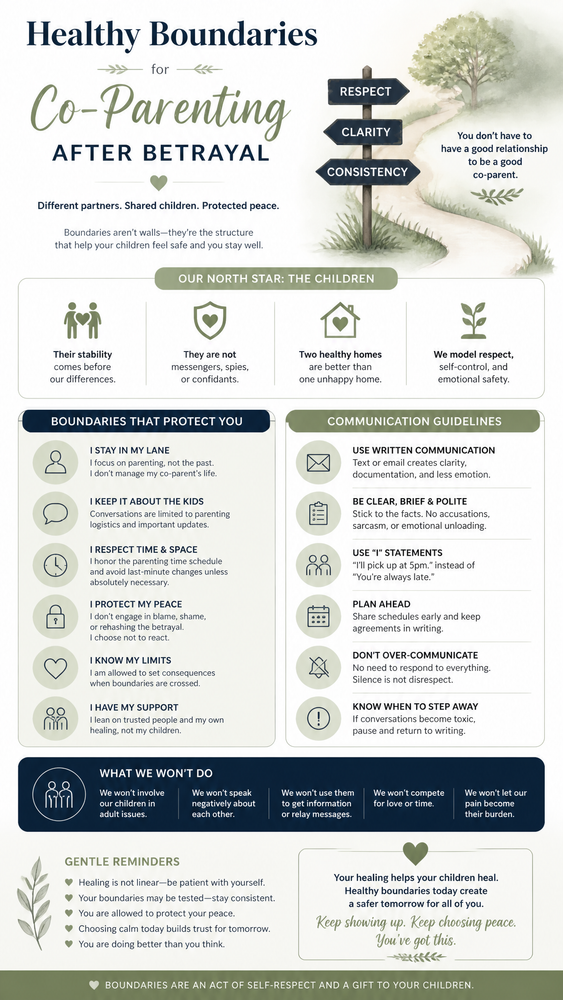
Co-parenting after betrayal isn’t about becoming friends again. It’s about running a two-household operation with someone who broke your trust, and doing it without setting the kids on fire in the process. This guide skips the feelings-first approach. It’s a toolkit: scripts, rules, and decision points for the moments that actually come up.
S.J. Howe built these frameworks from her own experience navigating separation and high-conflict co-parenting, working alongside a professional counsellor co-author. The scenarios below aren’t abstract. They’re the recurring 6pm handoff argument, the guilt-trip text after a missed call. The exact flashpoints that make co-parenting hard.
What Co-Parenting Actually Requires When Trust Is Gone
Co-parenting means two parents coordinate directly on their kids’ lives. Schedules, school events, medical decisions. You talk, you plan, you show up together sometimes. It works when both people can keep conflict separate from logistics.
After betrayal, that’s a big ask. You’re not just splitting a calendar. You’re negotiating with someone who lied to you, possibly for years, and you still need to agree on bedtime rules.
Co-parenting doesn’t require forgiveness. It requires function. You can hate what your ex did and still run a clean, workable schedule with them. Those are two separate skills. Only one of them matters for the kids’ sake.
Co-Parenting vs. Parallel Parenting: Which One You Actually Need
Standard co-parenting assumes some baseline cooperation. You can text about a schedule change without it turning into a fight about the affair.
Parallel parenting is the fallback when that baseline doesn’t exist. Family law and mediation professionals commonly describe it as the practical answer when regular co-parenting communication keeps collapsing into conflict. Under parallel parenting, contact drops to the minimum needed. Each parent handles their own time independently, with detailed written agreements instead of ongoing conversation. Handoffs happen in neutral places, often at school pickup instead of a doorstep.
Ask yourself one question: does a simple logistics text usually stay a logistics text, or does it turn into a fight within three messages? If it’s the second one, you likely need parallel parenting, not standard co-parenting. That’s not failure. It’s a structural fix for a communication problem that isn’t going away on its own.
The Communication Rules That Prevent Most Fights
Most co-parenting conflict isn’t about the kids. It’s about tone, timing, and old wounds sneaking into new conversations. Fixing that takes rules, not willpower.
Setting a Business-Only Communication Standard
Treat every message like it’s going to a colleague you don’t fully trust. That means logistics only. No commentary on the past, no questions about their personal life.
Picture this text at 9pm: “Running late tomorrow, can you do pickup at 5 instead of 4:30?” That’s a fine message. Now picture the version that also says “like you were always running late when we were together.” One of those gets a calm reply. The other starts a fight.
Set a response window, like 24 hours for non-urgent messages, so you’re not expected to answer at 11pm. Keep every message to one topic. If your ex adds an emotional jab, don’t respond to it. Answer only the logistics part and let the rest sit unanswered.
When and How to Start Documenting Everything
Start documenting the moment communication turns rocky, or immediately if you’re heading toward mediation or court. Waiting until things get bad means you’re reconstructing history from memory, which never holds up as well as a real-time record.
A parent who switches from reactive texting to a documented, timestamped log often sees fewer arguments escalate. Both sides know a written trail exists, and that alone changes behavior.
Keep everything in one place: a dedicated app or a shared document you control. Save schedule changes, missed pickups, and any messages that cross the business-only line. For a full walk-through of tools and formats, see how to document co-parenting communication with a difficult ex.
Handling the Moments Kids Actually Ask About
Kids don’t ask about custody schedules. They ask “why,” and they ask it at the worst possible times: bedtime, in the car, mid-homework.
What to Say When Your Child Asks Why You’re Divorcing
Keep the answer short, honest, and age-appropriate. Don’t name the affair to a young child. Don’t say “your dad broke our family.” Something closer to “we couldn’t work things out as a couple, but we both still love you and that’s not changing” holds the line without lying.
Older kids may ask more directly, and they may already know more than you think. For exact scripts by age and situation, what to say when your child asks why you’re divorcing covers this in depth.
Keeping Kids Out of Adult Conflict
Kids end up as messengers, spies, or comfort objects for a hurting parent. All three damage them, even when it doesn’t feel that way in the moment.
Don’t ask a child what happened at the other house. Don’t send a message through your child that you should be sending to your ex directly. Don’t tell your child their other parent is the reason for the divorce, even when it’s true. That creates a loyalty bind: the child feels like loving one parent betrays the other. It does lasting harm, and it’s avoidable.
If your child brings up something from the other house, listen without digging for details. Redirect: “That sounds like something to talk about with your mom/dad,” not a follow-up question.
Boundaries That Keep Slipping (and How to Hold Them)
Some flashpoints repeat no matter how well you’ve set up your communication rules. These two come up constantly.
Handling the New Partner Question
The new-partner conversation usually shows up as a demand: “You have to tell me before you introduce anyone to the kids.” That’s reasonable to agree to in principle. Most parenting plans benefit from a notice period, and waiting a few months before introducing a new partner to kids gives everyone time to adjust.
What’s not reasonable is your ex vetoing who you date, or turning every new-relationship update into a conflict trigger. Separate the two issues clearly: notice about introducing someone to the kids is a parenting decision. Your dating life is not.
Script: “I’ll let you know before I introduce anyone to the kids, same as we agreed. My dating life outside that isn’t something we’re negotiating.”
What to Do When Your Ex Breaks an Agreement
A missed pickup or a late drop-off happens sometimes. A pattern of it is different. Address the pattern, not each individual instance.
Document the violation the same day: date, time, what was agreed, what happened instead. Don’t relitigate it over text. Send one factual message: “You were 40 minutes late for the 4pm pickup on Tuesday. Going forward I need advance notice if you’ll be late.” No commentary, no accusation, just the fact and the expectation.
If the pattern continues after two or three documented instances, that’s your signal to move from managing it yourself to bringing in outside help.
When Co-Parenting Isn’t Working: Escalation and Exit Options
Some conflict resolves with better rules. Some doesn’t, and pretending otherwise just extends the damage to your kids and your own bandwidth.
Signs You Need Mediation or a Parenting Coordinator
Watch for these signals. Every logistics text turns into an argument no matter how neutral your wording is. Your ex ignores the documented agreement repeatedly. You’re avoiding communication altogether because it’s not safe or productive. Your child is showing signs of stress tied to the conflict between houses.
A mediator helps you renegotiate specific terms. A parenting coordinator, where available in your area, takes on an ongoing role, making binding-ish decisions on disputes so you’re not litigating every disagreement. Either option moves conflict out of your direct messages and into a structured process, which is often the point where things actually calm down.
Deciding Whether to Renegotiate the Custody Agreement

If violations are recurring and documented, and mediation isn’t fixing the pattern, it may be time to revisit the custody agreement itself. That’s a bigger step than a single conversation. It usually means legal counsel, your documentation log, and a clear list of what specifically isn’t working.
Renegotiation isn’t a punishment. It’s an acknowledgment that the original agreement didn’t anticipate the level of conflict you’re actually dealing with.
If you’re still working through the bigger question of whether the relationship itself is over or salvageable, that’s a separate decision from any of the co-parenting logistics above. The decision framework for staying or leaving after an affair is built for that specific question. And if you’re early in this, still in the immediate aftermath of discovery, the first 48 hours after discovering an affair covers the ground before co-parenting logistics even become the priority.
None of this requires you to feel okay about what happened. It requires a set of rules you can run on autopilot, even on your worst day. If you want the exact scripts, templates, and documentation tools referenced throughout this guide in one place, After the Affair Hub’s high-conflict co-parenting course builds them out step by step. It’s a toolkit, not therapy, and it’s built for exactly this fight.