Table of Contents
The clock reads 5:17 PM. Your ex is seventeen minutes late for pickup. No text, no call, no explanation. Your chest tightens, your mind races through every past betrayal, and the urge to send an angry message feels overwhelming.
This is the exact moment where most advice fails you. Telling someone to “document everything” or “stay calm” is useless when you’re standing alone on a curb while your child watches you panic. You don’t need general legal principles right now. You need specific words that protect your position without escalating the conflict.
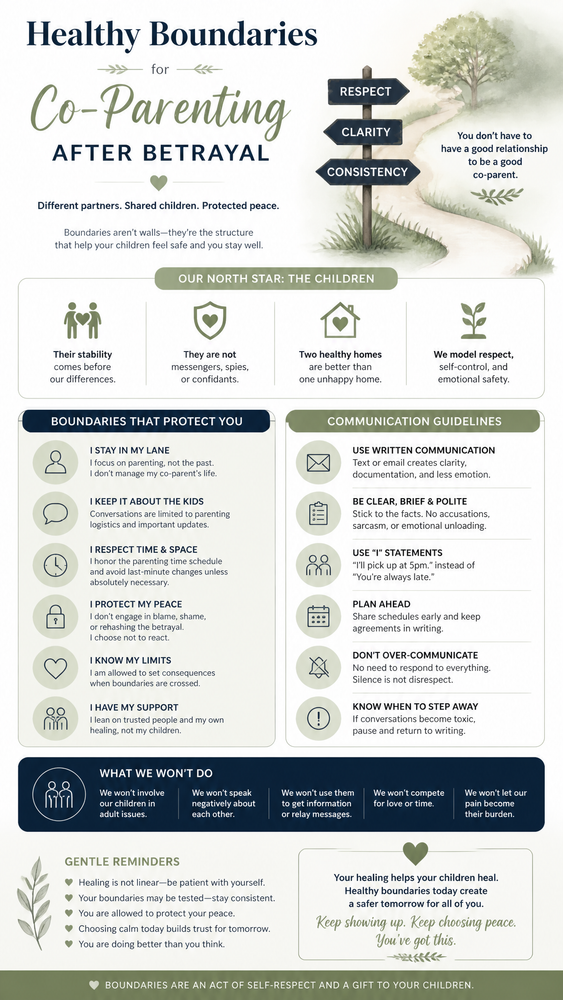
Knowing how to respond when your ex won’t follow the parenting plan is a skill built on preparation, not emotional regulation in the moment. A pre-written parenting plan violation script cuts your cognitive load during high-stress moments and creates an admissible record of the event at the same time. Our high-conflict co-parenting frameworks were built from lived experience with betrayal and separation, then refined with clinical input to address specific recurring flashpoints rather than general processing. These scripts aren’t about being polite. They’re tactical tools that enforce boundaries while stripping out the emotional reactivity opposing counsel will later use against you.
Why Generic Advice Fails When Your Ex Won’t Follow the Parenting Plan
Standard family law guidance assumes two rational actors trying to solve a logistical problem. That rarely describes the reality of post-betrayal co-parenting. When trust has been shattered by infidelity or deception, every schedule change feels like a fresh violation, not a simple calendar adjustment. Generic advice to “be flexible” ignores the safety concerns underneath your rigidity. You cannot cooperate with someone who has already shown they’ll weaponize that cooperation against you.
Vague directives create paralysis because they give a person in crisis nothing to actually do. A lawyer might tell you to keep records, but they rarely explain that a text reading “Pickup was scheduled for 5:00 PM per our order. Please confirm arrival time” creates a timestamped record, while “You’re late again!” documents only emotional distress. The former establishes facts for a judge. The latter establishes volatility for your ex’s attorney. Precision in language is what separates useful evidence from venting no court will admit.
Scripts function as both shield and sword. They shield you from saying something damaging in a moment of pain, and they cut through the noise to establish a clear pattern of non-compliance over time. Without that structure, you stay trapped in a cycle of reactive communication that drains you legally and emotionally.
Scripts for Late Pickups and Unauthorized Schedule Changes
Time-based violations are the most common friction point. They test your patience repeatedly while looking minor to anyone on the outside. Treat each instance as a discrete data point, not part of an emotional narrative about disrespect. Family law professionals consistently note that judges prioritize documented patterns of communication over isolated incidents when evaluating custody modifications, so your response has to serve the long-term evidentiary record even when it feels insufficient in the moment.
Copy-Paste Texts for Tardiness Without Excuses
When your ex is late and silent, your instinct is to demand an explanation or vent about the inconvenience. Both impulses undermine your legal standing and invite conflict you don’t need. State the objective fact, cite the governing document, and request confirmation without emotional coloring.
Use this for tardiness under thirty minutes: “Per our court order, pickup was scheduled for 5:00 PM. It is now 5:20 PM. Please confirm your estimated arrival time.” That sentence contains three things courts value: the agreed-upon standard, the current deviation, and a neutral request for information. It doesn’t ask “why,” which invites excuses you can’t verify and don’t need. It doesn’t say “again,” which implies a pattern you haven’t proven in this specific exchange.
For delays past thirty minutes, or repeated same-day lateness, add a consequence statement: “Per our court order, pickup was scheduled for 5:00 PM. It is now 5:45 PM. If you cannot arrive by 6:00 PM, I will arrange alternative care and log this as a missed parenting time per Section 4.2 of our agreement.” This moves from gathering information to enforcing a boundary, without threat or anger. You’re stating what the contract requires and what you’ll do if it stays unfulfilled.
These texts feel cold because they’re supposed to. Warmth signals you’re open to negotiation, and you’re not negotiating when a court order already exists.
Responding to Unilateral Calendar Swaps
Unauthorized schedule changes are especially destabilizing after betrayal, because they replicate the experience of having decisions made for you without your consent. Your ex may frame these as favors or emergencies, but accepting them without documentation teaches them the written agreement is optional. Knowing what to say when a co-parent breaks the schedule unilaterally means reaffirming the court order while still leaving room for legitimate flexibility when it’s properly requested.
When you’re notified of a change after the fact: “I received your message about swapping Tuesday for Thursday. Our court order specifies Tuesday as my parenting time. Future schedule changes must be requested in writing at least 48 hours in advance per Section 3.1. I expect [Child’s Name] to be returned at the originally scheduled time today.” This acknowledges the message without validating the change, cites the specific contractual requirement, and restates the outcome you expect.
If they claim an emergency justified acting unilaterally: “I understand emergencies happen. Going forward, please notify me as soon as possible so we can document the deviation and arrange make-up time per our agreement. For today, I need confirmation of return time.” This validates the concept of an emergency without conceding this instance qualified, keeps the documentation requirement in place, and stays focused on getting the immediate logistics resolved.
You’re not required to accommodate schedule changes that violate your court order, no matter how reasonable they sound. Compliance is voluntary. Enforcement is mandatory.
High Conflict Co-Parenting Scripts for Communication Refusals
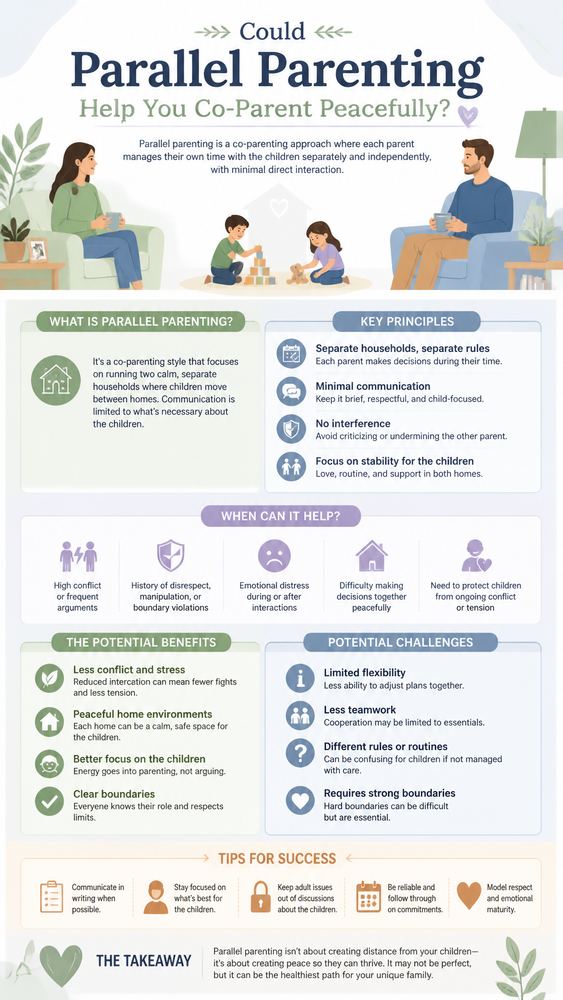
Silence and hostility function the same way in high-conflict dynamics: both block the cooperative exchange that co-parenting actually needs. Parallel parenting communication rules exist for exactly this situation, where traditional collaboration has already failed, and they restrict interaction to child-related logistics delivered through structured channels. These rules aren’t punishment. They’re protective architecture for your mental health and your child’s stability.
When They Ghost Essential Logistics
Refusal to respond to scheduling questions, medical appointments, or school events creates chaos that harms the child, and it can make you look unreasonable if you escalate. Show reasonable attempts at cooperation, and set clear deadlines that shift responsibility back onto the parent who’s not responding. How to enforce a parenting plan without going back to court often comes down to whether you can prove you tried direct communication first.
Initial inquiry: “[Child’s Name]’s pediatrician appointment is scheduled for March 15 at 2:00 PM. Please confirm by Friday at 5:00 PM whether you will attend or if I should proceed alone.” This gives every detail needed, sets a specific deadline, and states the default action if nobody responds. The deadline should be reasonable, typically 48 to 72 hours for non-emergencies, and the default action needs to be something you can actually pull off on your own.
Follow-up after a missed deadline: “I did not receive confirmation regarding the March 15 appointment by the stated deadline. I will attend with [Child’s Name] as planned and will share any relevant updates via email within 24 hours afterward.” This documents the non-response, confirms your action, and keeps information flowing without needing their participation. You’ve now created two timestamped records showing you tried to cooperate and solved the problem on your own.
Don’t send more messages before the deadline passes. Follow-ups sent early read as anxiety, not professionalism, and they dilute your original message.
Handling Hostile or Off-Topic Replies
Ex-partners who won’t cooperate often swap logistics for hostility, answering scheduling questions with accusations, old grievances, or references to past conflicts. Engaging with that rewards the behavior and hands them ammunition for future proceedings. Redirect to the original topic without acknowledging the provocation.
Template for redirection: “My previous message concerned [Child’s Name]’s spring break schedule. Please respond to that question by [date/time]. I will not discuss other topics through this channel.” This names the off-topic behavior indirectly by restating the actual topic, repeats the deadline, and declines to engage with anything irrelevant. “Through this channel” is deliberate. It leaves room for other venues, like mediation or therapy, while closing this one to abuse.
If the hostility continues across multiple exchanges: “I am ending this conversation until we can communicate about [specific topic] without personal commentary. I will resend my original question tomorrow at 9:00 AM and expect a response limited to that subject.” This states the boundary, names the condition for resuming, and lays out a concrete next step. You’re not threatening. You’re describing your own behavior in response to theirs.
This approach feels unsatisfying because it denies you the chance to defend yourself against false claims. That discomfort is the price of keeping your legal credibility intact.
What to Say When a Co-Parent Breaks the Schedule in Front of Kids
Kids absorb parental conflict as stress. Watching a schedule violation unfold creates insecurity that compounds the original betrayal trauma. Your priority here is stabilizing the child’s experience, not correcting your ex or winning the argument. Post-incident processing matters far more than confronting anyone in real time, and your words should reflect that.
Neutralizing Undermining Comments in Real Time
When your ex makes disparaging remarks about the parenting plan, your reliability, or the legal process in front of your child, the urge to correct the record is powerful. Resist it. Kids don’t need accurate legal analysis in that moment. They need evidence that their world stays predictable even when the adults in it don’t.
In the moment: “We can discuss schedule questions privately later. Right now, let’s focus on getting you settled.” This doesn’t validate or refute the comment, it just moves attention to the child’s immediate needs and pushes the real discussion to a better time. “Privately later” tells the child that adults have their own spaces for adult problems, which is reassuring on its own.
If the undermining keeps going despite the redirect: “I’m going to pause this conversation so we can all take a breath. We’ll revisit logistics when emotions are calmer.” This models regulation without shaming either parent, uses “we” so the child isn’t pulled into the middle, and holds the boundary without escalating. Showing the behavior you want beats demanding it out loud.
Never explain the legal details of custody orders to children during active conflict. They can’t process an adversarial framework as neutral information, and trying forces them to referee their own parents.
Post-Incident Processing With Children
Once the incident passes, kids often carry quiet confusion about what they saw and whether it means things are permanently unstable. Age-appropriate processing validates what they witnessed without assigning blame or airing adult grievances. This isn’t therapy. It’s basic relational maintenance that keeps kids from deciding the conflict is somehow their fault.
For younger children, ages 4 to 8: “Earlier, Mom/Dad and I had different ideas about the schedule. Grown-ups sometimes disagree about plans, and that’s okay. Your job is just to be a kid, and both of us love you no matter what.” This normalizes disagreement instead of treating it as a crisis, reassures continuity of care, and takes the child off the hook for anything adult. Concrete statements about love and their role matter more than abstract talk about fairness.
For older kids and teens: “You noticed tension about the schedule today. I want you to know that’s between us to work out, and it doesn’t change how safe or loved you are. If you have questions or feelings about it, I’m here to listen without judgment.” This acknowledges that they noticed, keeps the boundary around adult conflict, and invites dialogue without pushing for it. “Without judgment” matters, since teens often stay quiet because they’re afraid of looking disloyal to one parent.
Processing isn’t interrogation. Offer the space and let the child decide whether to step into it.
How to Enforce a Parenting Plan Without Going Back to Court
Litigation is expensive, slow, and traumatic. It should be a last resort, not the first response to every violation. Most parents need a way to tell actionable contempt apart from manageable friction, because logging every minor infraction leads to burnout without improving anything. Shifts toward parallel parenting typically happen when cooperative communication fails repeatedly across multiple documented instances, not after a single violation.
The Documentation Threshold: When to Log vs. When to Let Go
Not every breach deserves formal documentation, and treating them all the same devalues the serious ones. Minor deviations, like under fifteen minutes, an occasional forgotten item, or a testy tone in an otherwise compliant message, should generally be absorbed unless they add up to a clear pattern over weeks. Significant violations, like missed parenting time, unauthorized travel, refusing to share essential information, or endangerment, need immediate logging with full context.
The threshold question is impact. Does this violation materially affect the child’s wellbeing or your ability to exercise your court-ordered rights? Lateness that makes a child miss school or a medical appointment crosses the line. Lateness that just inconveniences you might not. Documenting co-parenting messages for court takes some judgment about what counts as meaningful non-compliance versus ordinary friction.
Run it through a simple filter: Is this a pattern? Is there measurable harm? Would a neutral third party call this significant? If fewer than two answers are yes, note it mentally and skip the formal log. Save your documentation energy for incidents that would hold up under judicial scrutiny.
Using Written Records as Leverage
Consistent use of neutral scripts builds evidentiary weight that often resolves disputes before litigation becomes necessary. Attorneys and mediators respond to organized records showing persistent non-compliance despite reasonable attempts at resolution, because those records suggest litigation would likely succeed. Tracking communication with a difficult ex turns scattered frustrations into a coherent narrative that supports a negotiated settlement.
Organize documentation chronologically, with brief factual summaries, attached messages, and noted impacts. Highlight patterns, for example “Late pickup occurred 6 times in 8 weeks despite written reminders,” rather than listing every incident on its own. Courts and mediators look for trends, not catalogs.
Bring this documentation to your attorney or mediator before filing motions. Often the mere existence of organized records prompts compliance, because the other parent realizes continued non-compliance now carries real consequences. Litigation is still available if leverage fails, but a lot of disputes resolve once someone is faced with credible evidence of an established pattern.
Enforcement is a spectrum, not a binary choice between doing nothing and a courtroom battle.
Parallel Parenting Communication Rules for Chronic Violators
When cooperative co-parenting proves impossible despite consistent scripting and documentation, structural boundaries become necessary to protect your mental health and the custody arrangement itself. Parallel parenting isn’t failure. It’s adapting to reality. Communication rules after infidelity or chronic non-compliance look nothing like standard co-parenting guidelines, because they start from the assumption of bad faith instead of good intentions.
Keep all communication in writing (email or a court-approved app) except for genuine emergencies involving immediate child safety. Verbal agreements are unenforceable and easy to distort. Written records are verifiable and permanent. This protects you from gaslighting and builds the evidentiary foundation you’ll need if a future modification becomes necessary.
Limit message frequency and content strictly to child-related logistics. Personal updates, relationship talk, and old grievances have no place in parallel parenting communication. Each message should contain only what’s necessary for the child’s care during the upcoming parenting period, written neutrally with no editorial commentary.
Set response protocols that don’t depend on the other parent’s cooperation. Assume some messages will go unanswered and build your contingency plans around that. Your peace can’t hinge on compliance with communication norms they’ve already broken repeatedly.
A parallel parenting plan template gives you the structural framework to put these rules into practice, turning abstract boundaries into operational ones you can actually enforce. This shift is protective, not punitive. It acknowledges that cooperation takes two willing participants and adjusts expectations to match.
Moving From Free Scripts to Comprehensive Enforcement Tools
Individual scripts handle acute moments well, but chronic non-compliance needs systematic tracking and a broader strategy that free resources can’t provide. The difference between managing isolated incidents and dealing with an entrenched pattern comes down to organization, consistency, and turning documentation into something you can actually use. Scattered texts and notes eventually overwhelm even the most diligent parent. Structured systems turn raw data into leverage.
Comprehensive toolkits organize interactions into court-ready formats without requiring legal expertise, bridging the gap between free advice and hiring representation. They include response templates, but also tracking mechanisms, pattern identification guides, and escalation steps calibrated to different levels of violation. This infrastructure cuts your cognitive load during a crisis while building evidentiary strength over time.
Our full high-conflict co-parenting toolkit goes beyond these sample scripts to give you the complete framework for sustained enforcement. It addresses the specific trust deficits that make standard co-parenting advice fall short for survivors of betrayal, with practical tools refined through lived experience and clinical input. Download the toolkit to get comprehensive scripts, checklists, and documentation frameworks built for the reality you’re actually facing, not the idealized version generic advice assumes.