Table of Contents
You caught him once. You forgave, you rebuilt, and six months later you found another name in his phone. That second discovery changes the question entirely. You’re no longer asking “how do we recover from an affair.” You’re asking whether you’re dealing with serial betrayal, a pattern, not an incident.
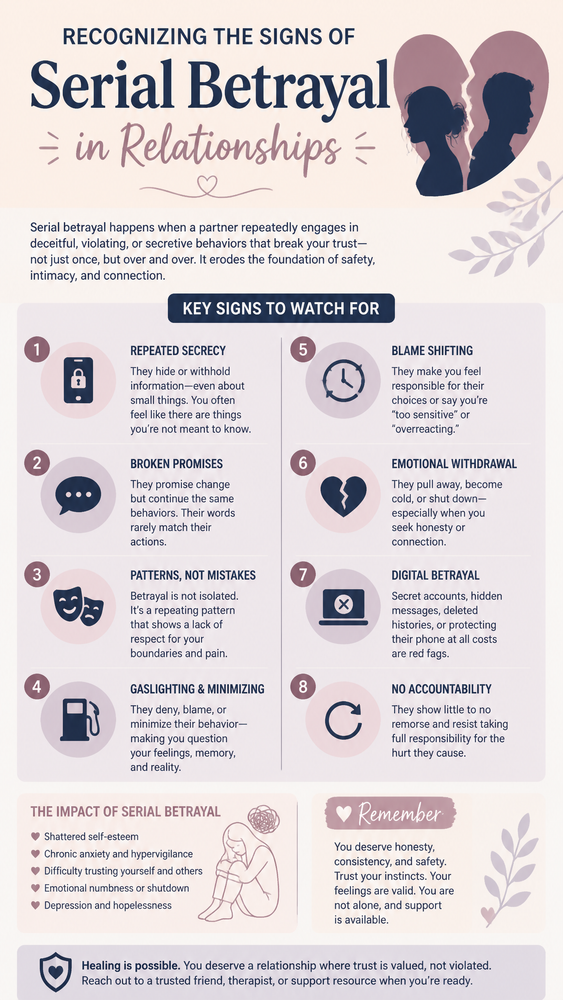
This matters because the two situations call for different responses. A one-time affair, worked through honestly, can end in a stronger marriage. Serial betrayal usually can’t be fixed with the same tools. It needs a different read on the person, and a different plan for yourself.
What Serial Betrayal Actually Means
Serial betrayal is a repeated pattern of infidelity or deception by the same person, across different relationships or within the same one. A number of partners doesn’t define it. The behavior underneath the repetition does: a habit of secrecy, a willingness to lie when convenient, and a track record of doing it again after being caught.
Some people cross a line once, under specific pressure, and never come close to it again. Others treat betrayal as a recurring solution to boredom, conflict, or ego. Serial cheaters fall into the second group. The affair isn’t the anomaly in their life. It’s a feature of how they operate.
Serial Cheater vs. One-Time Affair: The Real Difference
The difference isn’t just about counting how many times someone has been unfaithful. It’s about what happens after they get caught.
Someone who had one affair usually shows a specific kind of collapse. They’re ashamed. They answer questions instead of deflecting them. They accept consequences without negotiating them down.
A serial cheater treats getting caught as a temporary problem to manage. They apologize fast, promise changes fast, then quietly return to old habits once the heat is off. The tell isn’t the affair itself. It’s how automatically they know the script for damage control.
The Warning Signs You’re Dealing With a Repeat Pattern, Not a One-Time Mistake
Serial betrayal rarely announces itself with a single dramatic event. It shows up in small, repeatable behaviors that look almost too mundane to name.
Watch for these patterns:
- Compartmentalized secrecy, separate phones, hidden apps, deleted messages, or a password that changes right after a fight.
- Minimizing language, “it was nothing,” “we were just talking,” “you’re overreacting” used as a reflex, not a one-off defense.
- Love-bombing right after discovery, sudden gifts, grand declarations, or a burst of attentiveness that fades once your guard drops.
- A history that keeps resurfacing, an ex, a coworker, or a stranger who “coincidentally” reappears months or years later.
- Blame that always lands on you, your working hours, your mood, your “coldness” cited as the reason for someone else’s choice.
The pattern often looks like this: promises of change after discovery, a genuine quiet period of weeks or months, then a new name, a new platform, or the same old one resurfacing under a different excuse. If that cycle sounds familiar, you’re not imagining it.
The Remorse-vs-Regret Test
Remorse and regret sound similar. They aren’t.
Regret says, “I’m sorry I got caught.” It’s about consequences to them. Remorse says, “I understand what I did to you,” and it holds up even when no one is watching.
Therapists who work with infidelity often draw the line between a one-time affair and serial betrayal by checking whether the person shows sustained remorse and real structural change, or only situational regret when caught. Ask yourself which one you’ve actually seen from him or her. Not what they said in the first 48 hours. What they’ve done in the months since.
Common Excuses Serial Cheaters Repeat
A few lines show up again and again, almost word for word, across different serial betrayal cases:
- “It just happened, I didn’t plan it.”
- “We never actually had sex, so it’s not cheating.”
- “I only did it because things were bad between us.”
- “This time is different. I’ve changed.”
None of these are automatically lies. But when the same person uses the same excuse after the second or third discovery, it stops being an explanation. It becomes a pattern of its own.
Why Serial Cheaters Rarely Change on Their Own
Relationship researchers have long noted that a prior history of infidelity is one of the strongest predictors of future infidelity in the same person. That’s the uncomfortable part. Past behavior isn’t just a bad memory. It’s the best predictor you have.
Change, when it happens, is usually structural, not emotional. It comes from consistent outside accountability: therapy the person actually attends and works in, transparency that isn’t negotiated case by case, and real consequences that get enforced, not just threatened.
Without that structure, most people default to whatever got them through last time. Deception worked before. Under stress, it’s the reflex they reach for again. Willpower alone rarely beats a habit rehearsed for years.
This doesn’t mean change is impossible. It means change without infrastructure is unlikely. Hoping someone will change simply because they feel bad this time isn’t a plan.
Deciding Whether to Stay After Serial Betrayal
At some point, the analysis has to turn into a decision. You don’t need to fully understand why he or she did it before you decide what you’re going to do about it.
That’s the trap of serial betrayal: the endless loop of “but why did they do it, and what does it mean, and could I have prevented it.” Those questions matter later. Right now, the more useful question is simpler: given everything you now know about this pattern, what kind of life do you want going forward?
Questions to Ask Before You Decide
Before you commit to staying or leaving, sit with these directly:
- Has this happened more than once, with real time between the incidents?
- Did they disclose it themselves, or did you find it by accident, every time?
- What specifically has changed in how they operate, not just how they talk?
- Do you have kids, shared finances, or other stakes that change the calculus?
- What would you tell your closest friend to do in your exact situation?
If you want a more structured way to work through this, a decision framework for staying or leaving walks through the tradeoffs step by step. It won’t tell you what to choose. It will help you choose faster, and with less second-guessing afterward.
If You Stay: Protecting Yourself and Your Kids From the Next Round
Staying after serial betrayal is a legitimate choice. It’s not automatically weakness, and it’s not automatically foolish. But staying without new structure just resets the clock until the next incident.
If you stay, the goal shifts from trust to verification, at least for a while. That’s not a punishment. It’s how you protect yourself while you watch whether the changes actually hold.
Setting Boundaries That Actually Hold
A boundary that isn’t enforced is just a wish. Vague boundaries like “just be more honest” don’t survive contact with a serial cheater’s habits.
Specific, enforceable boundaries do better:
- Name the exact behavior that ends the relationship if repeated, not “no more cheating” in the abstract, but the actual acts.
- Set a concrete consequence in advance, and write it down so it isn’t renegotiated in the moment.
- Agree on transparency measures you can actually check, like shared location or account access, for a defined period.
- Decide who else needs to know, so shame doesn’t become the thing protecting the secrecy again.
Boundaries hold when the consequence is real and you’re prepared to follow through, even when it’s painful.
Co-Parenting Realities When Trust Is Broken Repeatedly
If you have kids and you’re staying, or staying only as co-parents while the romantic relationship ends, the rules of engagement matter more than ever.
Keep communication about the kids in writing wherever possible. That’s not paranoia. It’s protection for both of you if things escalate later, and it’s worth documenting communication with a difficult ex from the start rather than after a crisis.
If you’re staying together, communication rules for co-parenting after infidelity can help you separate the parenting logistics from the unresolved trust issues, so one doesn’t keep contaminating the other.
If the conflict is high and standard co-parenting keeps breaking down, a parallel parenting plan template reduces the contact points that tend to turn into new fights.
And if you do decide to separate, your kids will eventually ask why. Having language ready for what to say when your child asks why you’re divorcing matters more than getting the timing perfect.
If the Betrayal Involved a Coworker or Repeat Digital Contact
A repeat pattern with a coworker is a common variant of serial betrayal. Proximity and routine contact make discreet re-offending easier than with a stranger. Shared meetings, work trips, and messaging apps that look routine give a serial cheater built-in cover.
Digital contact adds its own layer. Deleted threads, secondary accounts, and “just checking in” messages can restart a pattern that looks, on the surface, completely dormant.
If this is your situation, general boundary language usually isn’t specific enough. You need no-contact scripts for a workplace affair that address the exact excuses a coworker relationship generates, shared projects, “professional” texts, and the plausible deniability that comes with an office setting.
Serial betrayal thrives on ambiguity. The clearer you get about what counts as contact, what counts as a violation, and what happens next, the harder it becomes for the pattern to repeat quietly.

None of this requires you to have all the answers today. It requires you to stop treating a repeated pattern like a one-time mistake, and to start building a plan, whether that plan is staying with real structure in place or leaving with a clear head. S.J. Howe built The After the Affair Hub from lived experience with betrayal, working alongside a counsellor co-author. The frameworks here come from what actually held up in the worst moments, not clinical theory alone. If you’re not sure which direction is right, the decision framework is the next concrete step, and the toolkit built around it gives you the scripts and boundaries to back it up once you’ve chosen.